The BuyRetaUK editorial team publishes laboratory-focused reference content on research peptides, analytical methods and Certificates of Analysis. All articles are written for in-vitro research contexts only.
View profile →Where this sits in the Retatrutide cluster.
Knowledge journey
Retatrutide research.
A UK laboratory reference for Retatrutide (LY3437943) research — triple GLP-1 / GIP / glucagon receptor agonist peptide, released at ≥99% HPLC-UV purity with batch-specific Certificates of Analysis for in-vitro research use.
- Batch-specific COA available
- Laboratory research use only
- Independent third-party testing
- UK dispatch
- Secure checkout

- Published
- June 2026
- Last reviewed
- June 2026
- Next review
- December 2026
- Version
- v1.1
- Reading time
- 7 min read
- Reviewed by
- BuyRetaUK Scientific Review Team
- Editorial team
- BuyRetaUK Editorial Team
- Review status
- Scientific review complete
Quick summary
Retatrutide research uses BuyRetaUK's UK laboratory-reference supply of LY3437943 — a triple GLP-1 / GIP / glucagon receptor agonist peptide. Every batch is released at ≥99% HPLC-UV purity with a batch-specific COA, dispatched from temperature-controlled UK storage for in-vitro research use only.
In short.
At a glance.
- Research compound
- Retatrutide (LY3437943)
- Class
- Triple receptor agonist research peptide
- Receptor targets
- GLP-1 · GIP · Glucagon
- Purity release
- ≥99% by HPLC-UV
- Identity
- Mass spectrometry confirmed
- Endotoxin
- Reported on batch COA
- Form
- Lyophilised powder
- Documentation
- Batch-specific COA in public verification library
- Storage
- 2–8 °C lyophilised · protect from light
- Intended use
- In-vitro laboratory research only
Key terms in retatrutide research.
- Triple receptor agonist
- A single peptide molecule engineered to bind and activate three distinct receptors — in Retatrutide's case GLP-1, GIP and glucagon.
- HPLC-UV purity
- High-Performance Liquid Chromatography with ultraviolet detection — the industry standard for quantifying peptide purity by area-percent.
- Certificate of Analysis (COA)
- A batch-specific quality record documenting identity, purity, appearance, and where applicable endotoxin and moisture data.
- Lyophilised
- Freeze-dried under vacuum — the standard shipping form for research peptides, preserving stability and enabling long-term cold storage.
- Reconstitution
- The controlled addition of bacteriostatic water to a lyophilised peptide vial to prepare a working stock at a defined concentration.
Retatrutide research overview.
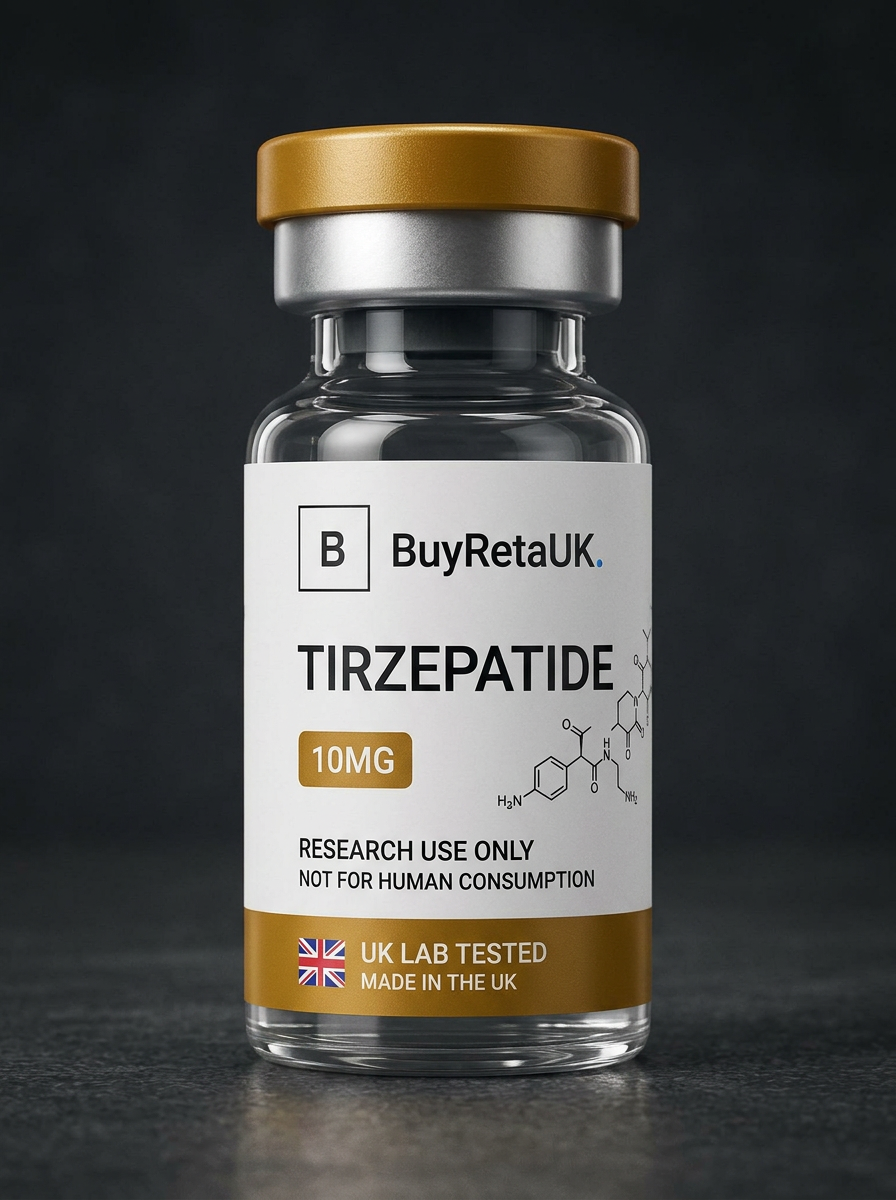
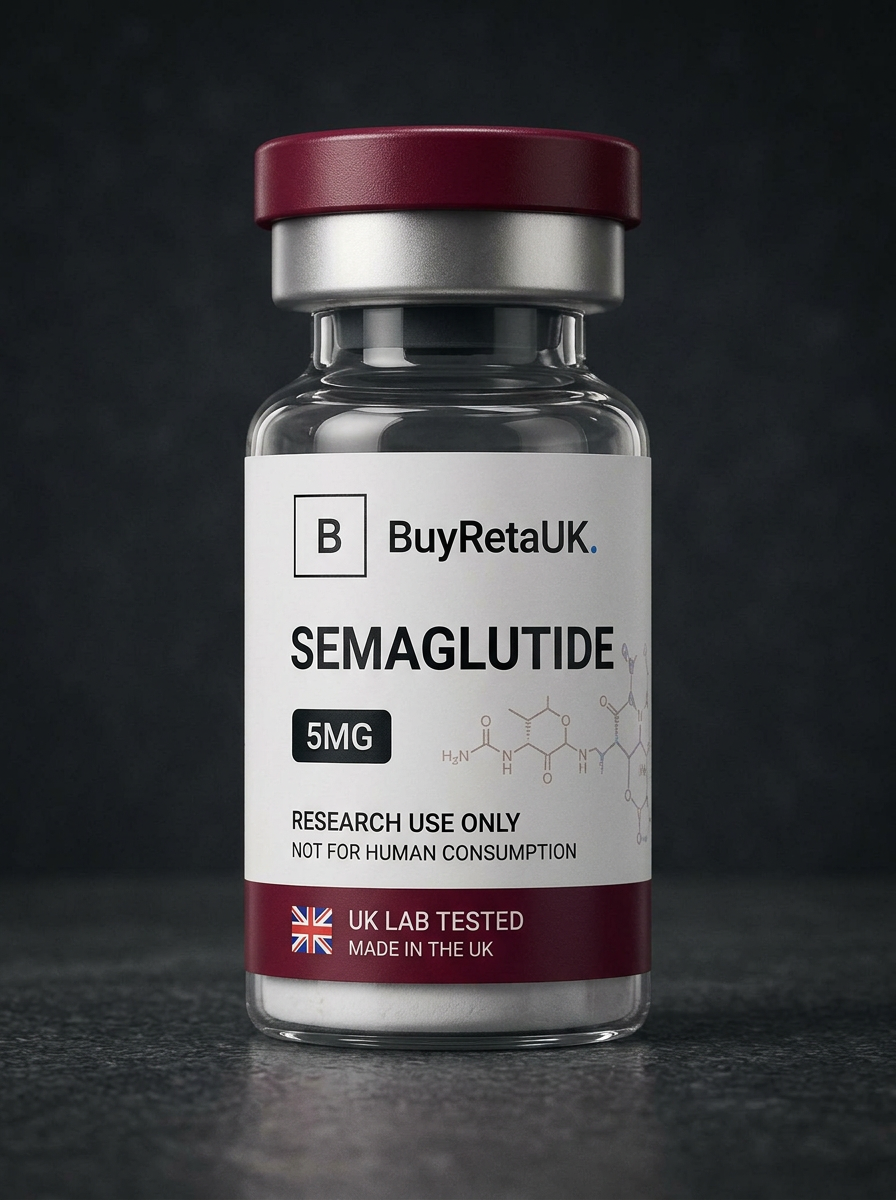
Retatrutide (LY3437943) is a synthetic 39-amino-acid peptide first characterised by Coskun and colleagues at Eli Lilly in 2022. It is the first clinically evaluated triple agonist to combine activity at the GLP-1, GIP and glucagon receptors within a single molecule, positioning it as a distinct pharmacological tool relative to established incretin comparators such as tirzepatide (dual GLP-1 / GIP) and semaglutide (single GLP-1).
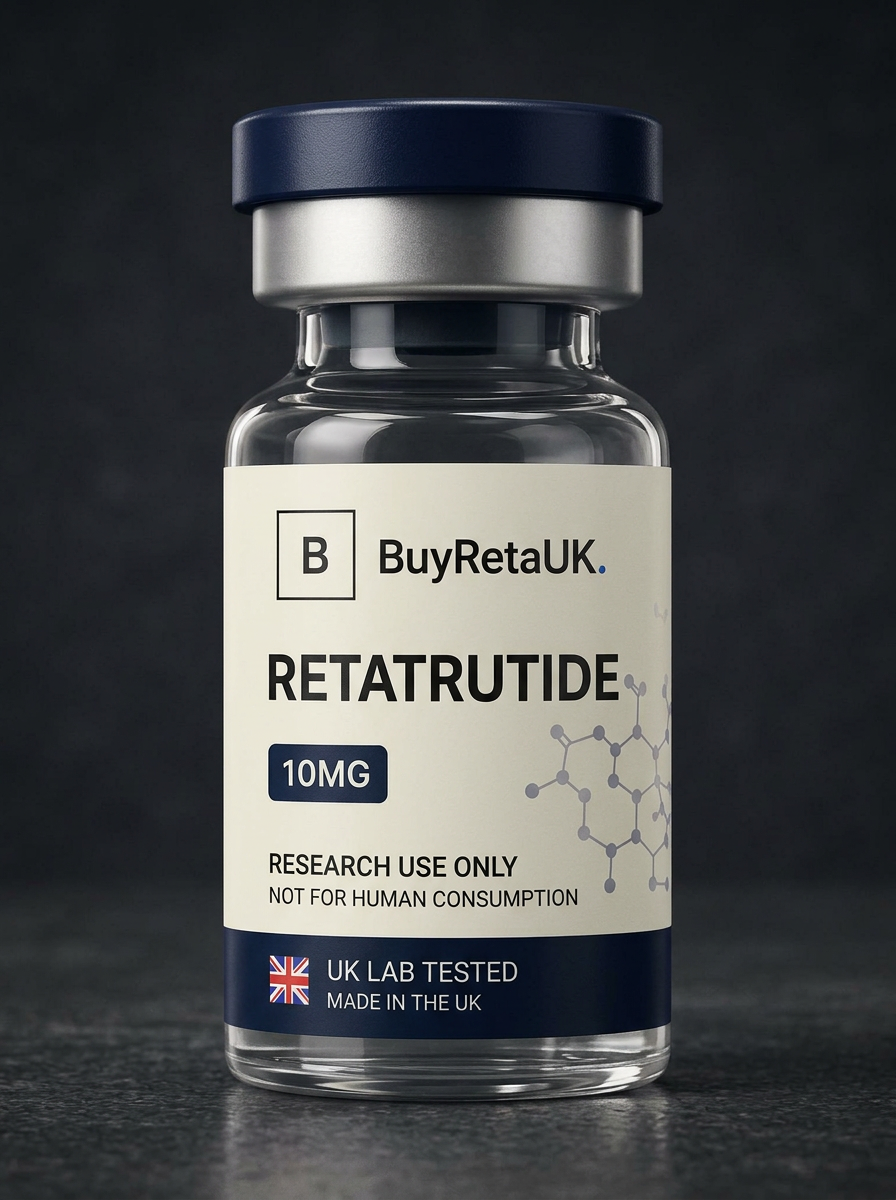
In a laboratory research context, retatrutide is used as a reference compound in receptor-binding, functional cAMP, β-arrestin recruitment and comparative agonist studies. Reproducibility of these assays depends on a well-characterised research-grade peptide: identity, purity and stability data must be documented on a per-batch basis and traceable to the vial in use. The full commercial supply framework is documented on the Retatrutide UK hub.
Why retatrutide is studied.
Interest in retatrutide within research pharmacology reflects three converging factors: the addition of glucagon receptor activity to a GLP-1 / GIP backbone, the resulting distinct energy-balance profile observed in preclinical models, and its role as a reference triple agonist for structure-activity comparisons across the incretin class.
- Reference triple agonist for GLP-1 / GIP / glucagon receptor pharmacology.
- Comparator for structure-activity studies against dual and single incretin agonists.
- Model peptide for characterising long-acting fatty-acid-conjugated GLP-1 analogues.
- Reproducibility benchmark for in-vitro receptor and functional assays.
Laboratory research standards.
BuyRetaUK operates against the peptide-specific quality attributes described in USP General Chapter <1503> and the specification framework of ICH Q6A. Every batch is released to a formal specification before it enters inventory, and no vial is dispatched without a traceable Certificate of Analysis.
- Purity: ≥99% by HPLC-UV area-percent.
- Identity: Mass spectrometry confirmation against theoretical monoisotopic mass.
- Appearance: White to off-white lyophilised cake or powder.
- Endotoxin: Reported on batch COA where determined.
- Traceability: Batch number printed on vial matches the published COA exactly.
Quality standards.
Reverse-phase HPLC quantifies purity as a percentage of total peak area. Release specification: ≥99%.
Learn more →Certificate of AnalysisEvery batch ships with a batch-specific COA reporting identity, purity and appearance.
Learn more →Laboratory QualityIndependent third-party analysis, temperature-controlled UK storage and full batch traceability.
Learn more →Batch VerificationCross-reference the batch number printed on your vial against our live COA library.
Learn more →Storage StandardsLyophilised at 2–8°C protected from light. Reconstituted stability ~30 days at 2–8°C.
Learn more →Product quality at BuyRetaUK.
Research-grade retatrutide is treated as a reference specimen within our range. Each batch passes an independent HPLC-UV purity check, mass-spec identity confirmation and visual appearance inspection before release. Batch-specific documentation is then published in our public verification library so any laboratory can cross-reference the vial in front of them.
Our full quality framework — release criteria, retained samples, stability monitoring and supplier qualification — is documented on the laboratory quality page.
Certificate of Analysis overview.
A Certificate of Analysis (COA) is the primary quality record for a peptide batch. For retatrutide it summarises the compound identity, batch number, manufacture date, purity method and result, mass-spec identity confirmation, appearance, and — where determined — endotoxin and moisture data.
Every batch of retatrutide dispatched by BuyRetaUK is accompanied by a batch-specific COA. Read the full Certificate of Analysis guide for a section-by-section walkthrough, or open the verification library to cross-reference a specific batch number.
HPLC testing overview.
High-Performance Liquid Chromatography with UV detection (HPLC-UV) is the reference method for quantifying peptide purity. A sample is separated over a reverse-phase C18 column under a controlled acetonitrile / water gradient with trifluoroacetic acid modifier, and eluting peaks are integrated by area-percent at a peptide-bond absorbance wavelength (typically 214–220 nm).
A ≥99% HPLC-UV release means the main retatrutide peak accounts for at least 99% of total integrated peak area. Impurity peaks — including truncated sequences, deletion products and oxidised variants — are visible and quantifiable, giving laboratories confidence that any signal observed in downstream assays reflects retatrutide itself and not confounding species.
Storage & handling.
- Lyophilised vials: store at 2–8 °C, protected from light. For extended storage >3 months, hold at −20 °C.
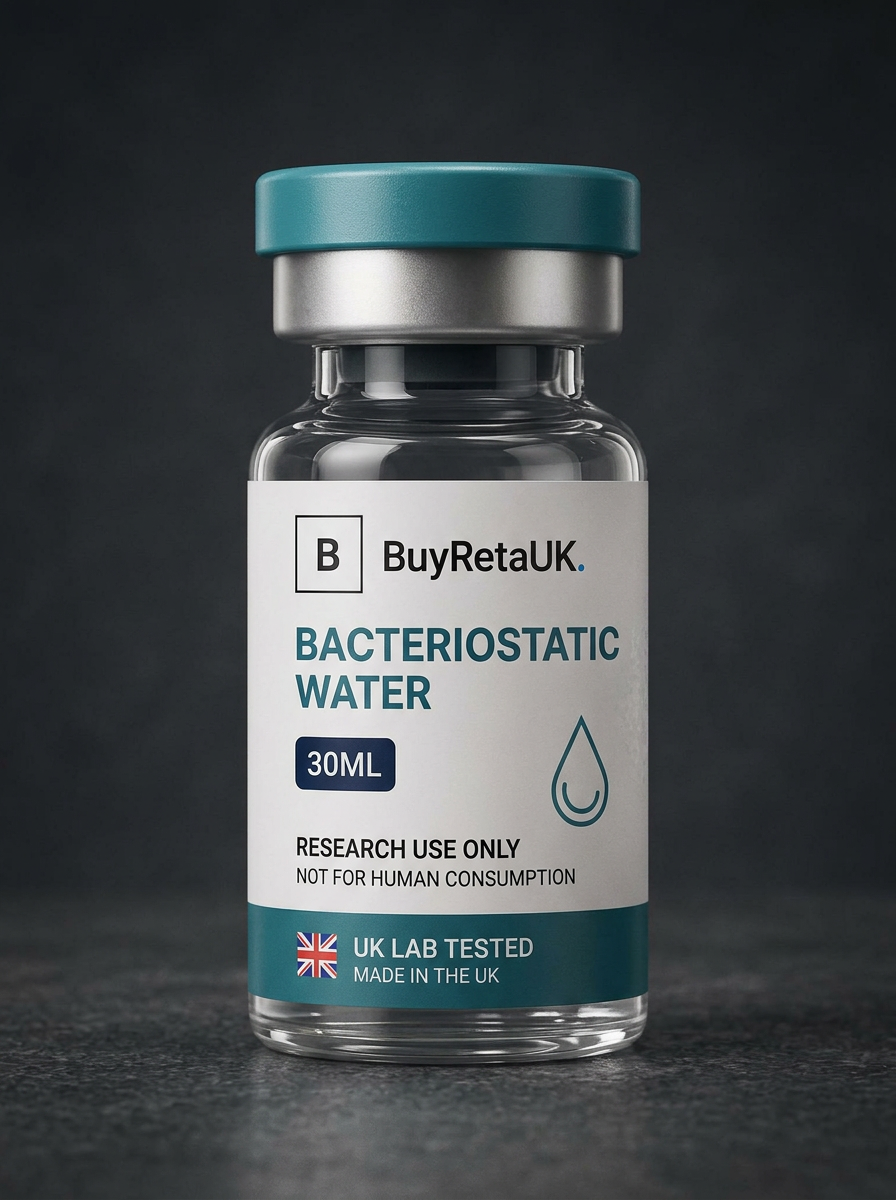
- Reconstitution: add bacteriostatic water down the inside wall of the vial and swirl gently — do not shake or vortex.
- Working stock: keep refrigerated at 2–8 °C and use within 30 days; avoid repeated freeze-thaw cycles.
- Handling: aseptic technique in a laminar flow environment where the study protocol requires it.
- Volumes: use the reconstitution calculator to convert vial strength and target concentration to a diluent volume.
Available retatrutide research products.
Available strengths.
Every vial ships with a batch-specific COA · UK dispatch
Product specifications.
- INN
- Retatrutide
- Research code
- LY3437943
- Class
- Triple receptor agonist research peptide
- Receptors
- GLP-1 · GIP · Glucagon
- Form
- Lyophilised powder
- Available strengths
- 10 mg · 20 mg · 30 mg · 40 mg
- Purity release
- ≥99% by HPLC-UV
- Identity
- Mass spectrometry confirmed
- Storage (lyophilised)
- 2–8 °C, protected from light
- Storage (reconstituted)
- Refrigerated; use within 30 days
- Documentation
- Batch-specific COA (public library)
- Intended use
- In-vitro laboratory research only
Buying considerations.
- Match strength to assay scale
Pilot in-vitro work is typically served by lower strengths; scaled comparative studies benefit from higher vial masses.
- Plan reconstitution up-front
Choose diluent volume and working concentration before reconstitution — pre-computed volumes protect analytical accuracy.
- Record batch numbers in your notebook
Log the vial batch alongside every result set for traceability against the published COA.
- Pair with a reference diluent
Standardise on bacteriostatic water for consistent reconstitution across batches and studies.
FAQs.
What is Retatrutide research?[+]
Retatrutide research refers to the laboratory investigation of LY3437943, a triple agonist peptide targeting GLP-1, GIP and glucagon receptors. It is conducted strictly in-vitro using research-grade material with documented purity and identity.
What purity is required for Retatrutide research?[+]
A ≥99% HPLC-UV purity release is the working laboratory standard. Below this threshold, impurity peaks can confound receptor-binding, potency and stability data.
How is Retatrutide characterised for research use?[+]
Identity is confirmed by mass spectrometry against the theoretical monoisotopic mass. Purity is quantified by HPLC-UV. Endotoxin, appearance and moisture data are reported on the batch-specific Certificate of Analysis.
What documentation ships with BuyRetaUK Retatrutide?[+]
Every vial is traceable to a batch-specific COA published in our public verification library. Cross-reference the batch number printed on the vial against the COA — the numbers must match exactly.
How should Retatrutide be stored during research?[+]
Lyophilised vials are stored at 2–8 °C, protected from light. Once reconstituted with bacteriostatic water, working stocks are held refrigerated and used within 30 days. Avoid repeated freeze-thaw cycles.
How does Retatrutide differ from Tirzepatide and Semaglutide in research contexts?[+]
Retatrutide is a triple agonist (GLP-1 / GIP / glucagon). Tirzepatide is a dual agonist (GLP-1 / GIP). Semaglutide is a single GLP-1 agonist. The three form the standard incretin reference set for comparative receptor pharmacology.
Is Retatrutide legal to buy in the UK for research?[+]
Yes — Retatrutide is supplied as a research chemical for in-vitro laboratory use. It is not offered, marketed or discussed for human or veterinary administration.
Scientific sources & further reading.
- [1]Coskun T. et al. (2022) LY3437943, a novel triple GIP, GLP-1 and glucagon receptor agonist. Cell Metabolism, 34(9) DOI: 10.1016/j.cmet.2022.07.013DOI →
- [2]Jastreboff A.M. et al. (2023) Triple-hormone-receptor agonist retatrutide for obesity — a phase 2 trial. New England Journal of Medicine, 389(6) DOI: 10.1056/NEJMoa2301972DOI →
- [3]Urva S. et al. (2022) LY3437943, a novel triple GIP/GLP-1/glucagon receptor agonist: pharmacokinetics, safety and tolerability. The Lancet, 400(10366) DOI: 10.1016/S0140-6736(22)02033-5DOI →
- [4]United States Pharmacopeia (2023) General Chapter <1503> Quality Attributes of Synthetic Peptide Drug Substances. USP-NF
- [5]ICH Harmonised Guideline (1999) Q6A Specifications: Test Procedures and Acceptance Criteria for New Drug Substances and New Drug Products. International Council for Harmonisation
Peer-reviewed citations are added as each article is expanded. See our editorial standards for our sourcing and accuracy commitments.
Every editorial article is reviewed against our accuracy commitment and quality-assurance checklist before publication. Named reviewer profiles are added as our reviewer network expands.
View profile →How this content is produced.
Every article follows a documented editorial process — sourcing, scientific review, update cadence and correction policy — so researchers can rely on what we publish.
Read the full editorial standards →Your research-to-checkout journey.
Educational first. Each step is optional — start wherever you are in your research.
- Step 1ResearchUnderstand mechanism, class and study context.
- Step 2ComparisonSee how compounds differ in receptor profile.
- Step 3Laboratory qualityHPLC-UV purity, mass-spec identity, endotoxin data.
- Step 4Certificates of analysisVerify your batch in the public COA library.
- Step 5ProductsChoose a strength — every vial ships with COA.
- Step 6CheckoutEncrypted checkout, temperature-controlled UK dispatch.
How to research this topic.
Recommended reading path
- Step 01Start here — What is Retatrutide?
Compound overview, receptor profile and research framing.
- Step 02Compare with Tirzepatide
Triple vs dual incretin agonist — how they differ.
- Step 03Compare with Semaglutide
Triple agonist vs single GLP-1 agonist.
- Step 04Understand Certificates of Analysis
How to verify identity, purity and batch quality.
- Step 05Browse Retatrutide products
Every retatrutide variant with lab data.
- Step 06Calculate reconstitution
Solvent volume and dose-per-unit calculator.
Retatrutide at a glance.
Topic overview
- Retatrutide
- GLP-1
- GIP
- Glucagon
- Triple Agonist
- Incretin
Compare research compounds.
Triple vs dual incretin agonist — receptor profile and research framing.
View comparison →Side by sideTriple agonist vs single GLP-1 — class, mechanism and lab context.
View comparison →Multi-compoundAll GLP-1 / GIP / glucagon research compounds in one place.
View comparison →Retatrutide reference reading.
A laboratory overview of retatrutide (LY3437943) — a triple agonist research peptide acting on the GLP-1, GIP and glucagon receptors.
6 min read →Purity & Laboratory TestingThe quality standards BuyRetaUK applies to every batch — sourcing, analytical testing, storage and traceability.
5 min read →Storage & HandlingHow to store lyophilised research peptides and reconstitute them correctly for laboratory use.
4 min read →RetatrutideBackground on retatrutide in the academic literature — receptor pharmacology, study context and analytical handling.
8 min read →Explore related collections.
Research guides, comparisons and laboratory reference material.
Browse collection →CollectionThe UK commercial hub for research-grade Retatrutide — lab data, COAs and dispatch.
Browse collection →CollectionThe full retatrutide range with research context and lab data.
Browse collection →Retatrutide & standard comparators.
Frequently researched together.
Certificate of Analysis.
Every batch of Retatrutide ships with a third-party HPLC and mass-spec Certificate of Analysis. Browse the live COA library to verify your lot.
Tools & resources.
Frequently asked questions.
Is retatrutide approved for human use?
No. Retatrutide is supplied strictly for laboratory research and is not approved for human or veterinary administration.
Read: What is Retatrutide? →What receptors does retatrutide act on?
In published research it has been characterised as a triple agonist acting on the GLP-1, GIP and glucagon receptors.
Read: What is Retatrutide? →How should retatrutide be stored?
Lyophilised vials are stored at 2–8°C, protected from light. Once reconstituted with bacteriostatic water, store refrigerated and use within 30 days.
Read: What is Retatrutide? →Which is the newer research compound?
Retatrutide is the more recently characterised compound in the academic literature, while tirzepatide is the more established reference.
Read: Retatrutide vs Tirzepatide →Continue your research.
Cornerstone research overview — mechanism, class and study context.
Read guide →ComparisonRetatrutide vs TirzepatideTriple vs dual incretin receptor profile — side-by-side research framing.
View comparison →VerificationCertificate libraryCross-reference your batch number against the public COA library.
Open library →