For laboratory research use only · Not for human consumptionFree UK next-day delivery
Knowledge journey

Where this sits in the Retatrutide Comparisons cluster.

Knowledge journey

  1. collectionRetatrutide
  2. guideComparisons
  3. comparisonRetatrutide vs Tirzepatide
  4. comparisonRetatrutide vs Semaglutide
  5. comparisonSemaglutide vs Tirzepatide
  6. collectionGLP-1 Research Hub
  7. guideWhat is Retatrutide?
  8. coaCertificate of Analysis Guide
  9. productBuy Retatrutide
Comparison guide · Product Comparisons

Retatrutide vs Semaglutide.

A laboratory-focused comparison of Retatrutide (LY3437943) and Semaglutide — triple receptor agonist versus single GLP-1 receptor agonist. Receptor profile, mechanism, class and analytical release for UK researchers.

Published
June 2026
Last reviewed
June 2026
Next review
December 2026
Version
v1.1
Reading time
7 min read
Reviewed by
BuyRetaUK Scientific Review Team
Editorial team
BuyRetaUK Editorial Team
Review status
Scientific review complete
Quick answer

In short.

Retatrutide is a triple receptor agonist that acts on the GLP-1, GIP and glucagon receptors simultaneously. Semaglutide is a single GLP-1 receptor agonist. Both are supplied as lyophilised research peptides at ≥99% HPLC purity — retatrutide is used as the triple-incretin reference and semaglutide as the single-receptor GLP-1 reference in comparative research.
Key facts

At a glance.

  • Retatrutide: triple agonist (GLP-1 · GIP · glucagon)
  • Semaglutide: single agonist (GLP-1)
  • Both: lyophilised powder, ≥99% HPLC purity
  • Both: batch-specific COA with every order
  • Both: laboratory research use only
Side by side

The compounds.

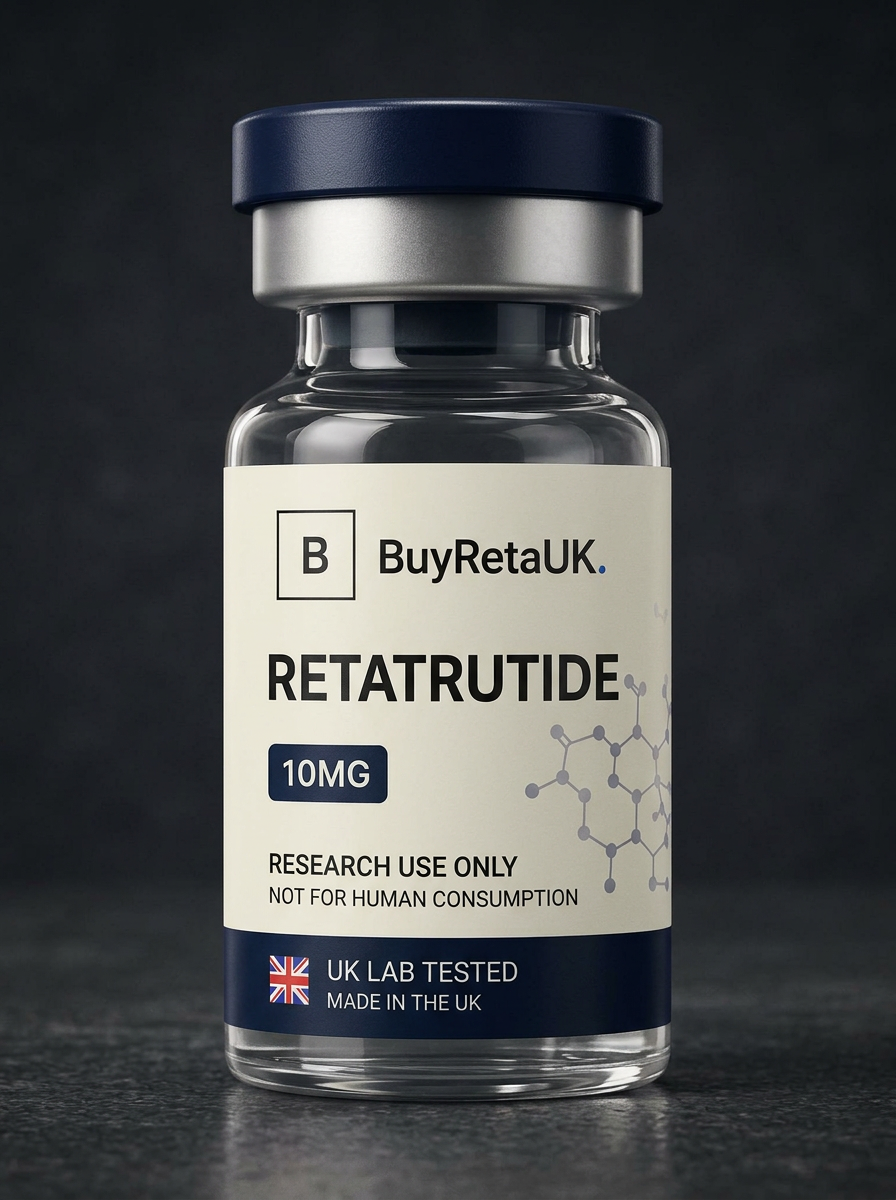
Retatrutide research peptide vial

Retatrutide

Triple receptor agonist targeting GLP-1, GIP and glucagon — the newest generation of incretin research peptides.

Shop Retatrutide →
Semaglutide research peptide vial

Semaglutide

The established single GLP-1 receptor agonist reference peptide, used across metabolic and glycaemic research models.

Shop Semaglutide →
Comparison table

Specifications.

FeatureRetatrutideSemaglutide
Receptor profileGLP-1 · GIP · GlucagonGLP-1 only
Compound classTriple agonist peptideSingle-receptor GLP-1 agonist
Primary research interestTriple-hormone synergism, energy expenditure, body compositionGLP-1 pathway biology and glycaemic research
Analytical release≥99% HPLC-UV, mass spec, endotoxin≥99% HPLC-UV, mass spec, endotoxin
FormLyophilised powderLyophilised powder
Storage2–8°C dark; ~30 days reconstituted2–8°C dark; ~30 days reconstituted
Research maturityEmerging triple-incretin referenceEstablished single-GLP-1 reference
Research context

Why compare them.

Semaglutide is the anchor GLP-1 reference in modern peptide research — a well-characterised single-receptor agonist against which every newer incretin candidate is measured. Retatrutide sits at the opposite end of the class spectrum: three receptor targets in a single molecule, adding GIP and glucagon activity to the GLP-1 axis.

For laboratory groups isolating the contribution of GLP-1 alone versus combined incretin signalling, the two compounds are the natural comparators. The paired middle-ground compound — tirzepatide (dual GLP-1 / GIP) — is covered in our companion Retatrutide vs Tirzepatide guide.

All observations here are laboratory research context. BuyRetaUK does not make clinical, therapeutic or off-label claims.

Definitions

Key terms.

Retatrutide (LY3437943)
Triple receptor agonist acting on GLP-1, GIP and glucagon receptors.
Semaglutide
Single GLP-1 receptor agonist and the most widely referenced GLP-1 research peptide.
GLP-1
Glucagon-like peptide-1: an incretin hormone regulating insulin release and appetite.
Triple / single agonist
Peptides engineered to activate three vs one receptor respectively.
Frequently asked questions

FAQs.

What is the core difference between retatrutide and semaglutide?[+]

Retatrutide activates three receptors (GLP-1, GIP and glucagon). Semaglutide activates one (GLP-1). Retatrutide is used where research questions require combined incretin activity; semaglutide is the isolated GLP-1 reference.

Are both compounds long-acting?[+]

Yes — both are engineered as long-acting peptides suitable for weekly-cadence research protocols in the studies that reference them.

Can I use both in the same experiment?[+]

Comparative research designs frequently include both to attribute observed effects to GLP-1 alone versus combined GLP-1 / GIP / glucagon activity. Sourcing both from matched release specifications supports that comparison.

Do BuyRetaUK batches ship with COAs?[+]

Yes — every batch of both compounds ships with a batch-specific Certificate of Analysis reporting HPLC purity, mass-spec identity and endotoxin data.

Are these compounds approved for human use?[+]

No. BuyRetaUK supplies both strictly for in-vitro laboratory research. Neither is offered by BuyRetaUK for human or veterinary administration.

References

Scientific sources & further reading.

  1. [1]Jastreboff A.M. et al. (2023) Triple-hormone-receptor agonist retatrutide for obesity — a phase 2 trial. New England Journal of Medicine, 389(6) DOI: 10.1056/NEJMoa2301972DOI →
  2. [2]Coskun T. et al. (2022) LY3437943, a novel triple GIP, GLP-1 and glucagon receptor agonist. Cell Metabolism, 34(9) DOI: 10.1016/j.cmet.2022.07.013DOI →
  3. [3]Lau J. et al. (2015) Discovery of the once-weekly glucagon-like peptide-1 (GLP-1) analogue semaglutide. Journal of Medicinal Chemistry, 58(18) DOI: 10.1021/acs.jmedchem.5b00726DOI →

Peer-reviewed citations are added as each article is expanded. See our editorial standards for our sourcing and accuracy commitments.

Editorial team
BuyRetaUK Editorial Team
Author · BuyRetaUK

The BuyRetaUK editorial team publishes laboratory-focused reference content on research peptides, analytical methods and Certificates of Analysis. All articles are written for in-vitro research contexts only.

View profile →
Scientific reviewer
BuyRetaUK Scientific Review Team
Scientific reviewer

Every editorial article is reviewed against our accuracy commitment and quality-assurance checklist before publication. Named reviewer profiles are added as our reviewer network expands.

View profile →
Editorial standards

How this content is produced.

Every article follows a documented editorial process — sourcing, scientific review, update cadence and correction policy — so researchers can rely on what we publish.

Read the full editorial standards →
Recommended reading path

How to research this topic.

Recommended reading path

  1. Step 01
    Start here — What is Retatrutide?

    Baseline understanding of the triple agonist.

  2. Step 02
    Compare with Tirzepatide

    Triple vs dual receptor profile.

  3. Step 03
    Compare with Semaglutide

    Triple vs single GLP-1 profile.

  4. Step 04
    Understand COAs

    Verify identity and purity of any compound.

  5. Step 05
    Browse compounds

    All GLP-1 / GIP / glucagon research peptides.

Topic overview

Retatrutide Comparisons at a glance.

Topic overview

Shop
Knowledge Hub
Comparisons
Collections
Batch verification

Every batch of Retatrutide, Semaglutide ships with a third-party HPLC and mass-spec Certificate of Analysis. Browse the live COA library to verify your lot.

Research tools
FAQ
Which is the newer research compound?

Retatrutide is the more recently characterised compound in the academic literature, while tirzepatide is the more established reference.

Read: Retatrutide vs Tirzepatide
Are both compounds GLP-1 agonists?

Yes — both act on the GLP-1 receptor, but retatrutide also acts on GIP and glucagon receptors.

Read: Retatrutide vs Semaglutide
Is retatrutide approved for human use?

No. Retatrutide is supplied strictly for laboratory research and is not approved for human or veterinary administration.

Read: What is Retatrutide?
What receptors does retatrutide act on?

In published research it has been characterised as a triple agonist acting on the GLP-1, GIP and glucagon receptors.

Read: What is Retatrutide?
Continue reading

Suggested next reading.

Product Comparisons
Retatrutide vs Tirzepatide

Side-by-side comparison of retatrutide and tirzepatide across receptor profile, research context and analytical considerations.

5 min read — Read guide →