The BuyRetaUK editorial team publishes laboratory-focused reference content on research peptides, analytical methods and Certificates of Analysis. All articles are written for in-vitro research contexts only.
View profile →Where this sits in the Retatrutide cluster.
Knowledge journey
Retatrutide storage.
The BuyRetaUK laboratory reference for storing Retatrutide (LY3437943) research peptide — recommended temperatures, freeze/thaw handling, light and moisture protection, post-reconstitution stability and common storage mistakes.
- Batch-specific COA available
- Laboratory research use only
- Independent third-party testing
- UK dispatch
- Secure checkout

- Published
- June 2026
- Last reviewed
- June 2026
- Next review
- December 2026
- Version
- v1.1
- Reading time
- 8 min read
- Reviewed by
- BuyRetaUK Scientific Review Team
- Editorial team
- BuyRetaUK Editorial Team
- Review status
- Scientific review complete
Quick summary
Store lyophilised Retatrutide sealed at 2–8 °C protected from light; hold at −20 °C beyond three months. Once reconstituted with bacteriostatic water, refrigerate at 2–8 °C, aliquot to limit freeze-thaw, and use within 30 days.
In short.
At a glance.
- Compound
- Retatrutide (LY3437943)
- Supplied form
- Lyophilised powder in sealed glass vial
- Short-term storage
- 2–8 °C, protected from light
- Long-term storage
- −20 °C, sealed, protected from light
- Reconstitution diluent
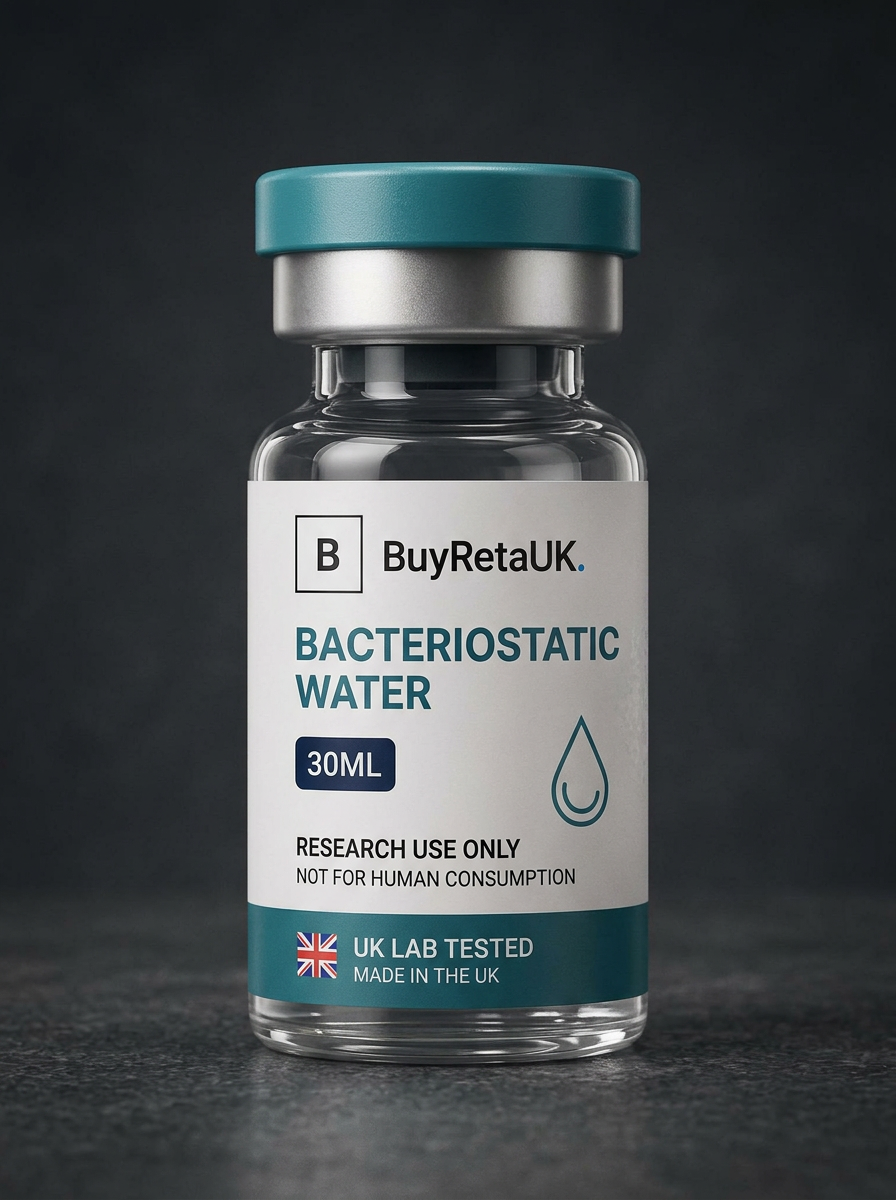
- Bacteriostatic water for injection
- Working stock storage
- Refrigerated 2–8 °C · use within 30 days
- Freeze-thaw tolerance
- Minimise cycles · aliquot before freezing
- Light sensitivity
- Protect from direct light throughout storage
- Moisture sensitivity
- Equilibrate to room temperature before opening
- Intended use
- In-vitro laboratory research only
Key storage terms.
- Lyophilised
- Freeze-dried under vacuum — the stable shipping and long-term storage form for research peptides such as Retatrutide.
- Reconstitution
- Controlled addition of a diluent (typically bacteriostatic water) to a lyophilised vial to produce a working stock at a defined concentration.
- Working stock
- The reconstituted peptide solution used at the bench; distinct from long-term lyophilised inventory.
- Freeze-thaw cycle
- One complete transition from a frozen state to a liquid state and back — each cycle risks incremental peptide degradation.
- Aliquot
- A small pre-portioned volume of working stock frozen individually so a single vial can be thawed for one use without cycling the parent stock.
- Cold chain
- The unbroken sequence of temperature-controlled handling and transport steps that maintain a peptide within its validated storage range.
Why storage matters.
Peptides such as Retatrutide are chemically defined polymers whose bench-relevant properties — receptor affinity, potency, and reproducibility in comparative assays — depend on maintaining the released purity profile documented on the batch Certificate of Analysis. Once released at ≥99% HPLC-UV purity, downstream degradation is driven almost entirely by local storage and handling.
The dominant degradation pathways for GLP-1-class peptides are hydrolysis of labile amide bonds, oxidation of methionine and tryptophan residues, and physical aggregation on repeated temperature cycling. Each is accelerated by inadequate temperature control, ambient moisture ingress and prolonged light exposure. Correct storage therefore protects both the scientific integrity of ongoing research and the traceability of results back to the released batch specification.
Recommended storage conditions.
| State | Temperature | Typical duration | Notes |
|---|---|---|---|
| Lyophilised, sealed | 2–8 °C | Up to 3 months | Original packaging, dark, low humidity. |
| Lyophilised, sealed | −20 °C | Long-term (>3 months) | Preferred for extended inventory. |
| Reconstituted working stock | 2–8 °C | Up to 30 days | In bacteriostatic water, sealed vial. |
| Reconstituted aliquots | −20 °C | Study-dependent | Single-use portions; thaw once. |
Values above align with the general peptide stability framework in ICH Q1A(R2) and USP General Chapter <1503>. Study-specific stability data should always take precedence where available.
Refrigeration & temperature guidance.
- Use a dedicated laboratory refrigerator with active temperature monitoring; domestic units drift outside 2–8 °C.
- Locate the vial away from the refrigerator door and away from the fan outlet — the door position cycles temperature on every open.
- Avoid frost-free freezers, which apply repeated warming cycles to prevent ice build-up and defeat the purpose of −20 °C storage.
- Log storage temperature ranges alongside each retatrutide batch used in a study — reproducibility questions almost always start with the storage record.
- Do not store retatrutide with volatile solvents or reactive reagents in the same enclosed cold space.
Freeze / thaw considerations.
Freeze-thaw cycling is the single most common cause of preventable peptide degradation. Ice formation and melting concentrate solutes at phase boundaries, promote aggregation, and mechanically stress the peptide. For Retatrutide, treat every reconstituted vial as a one-way resource: reconstitute, aliquot, freeze, and thaw individual aliquots on demand.
- Aliquot the working stock into single-use volumes immediately after reconstitution.
- Label each aliquot with batch number, reconstitution date and target concentration.
- Thaw on wet ice or at 2–8 °C — never at room temperature or under warm water.
- Do not refreeze a thawed aliquot: discard any unused volume.
- If a reconstituted vial appears cloudy, contains visible particulates, or shows a change from clear colourless solution, do not use it.
Light & moisture protection.
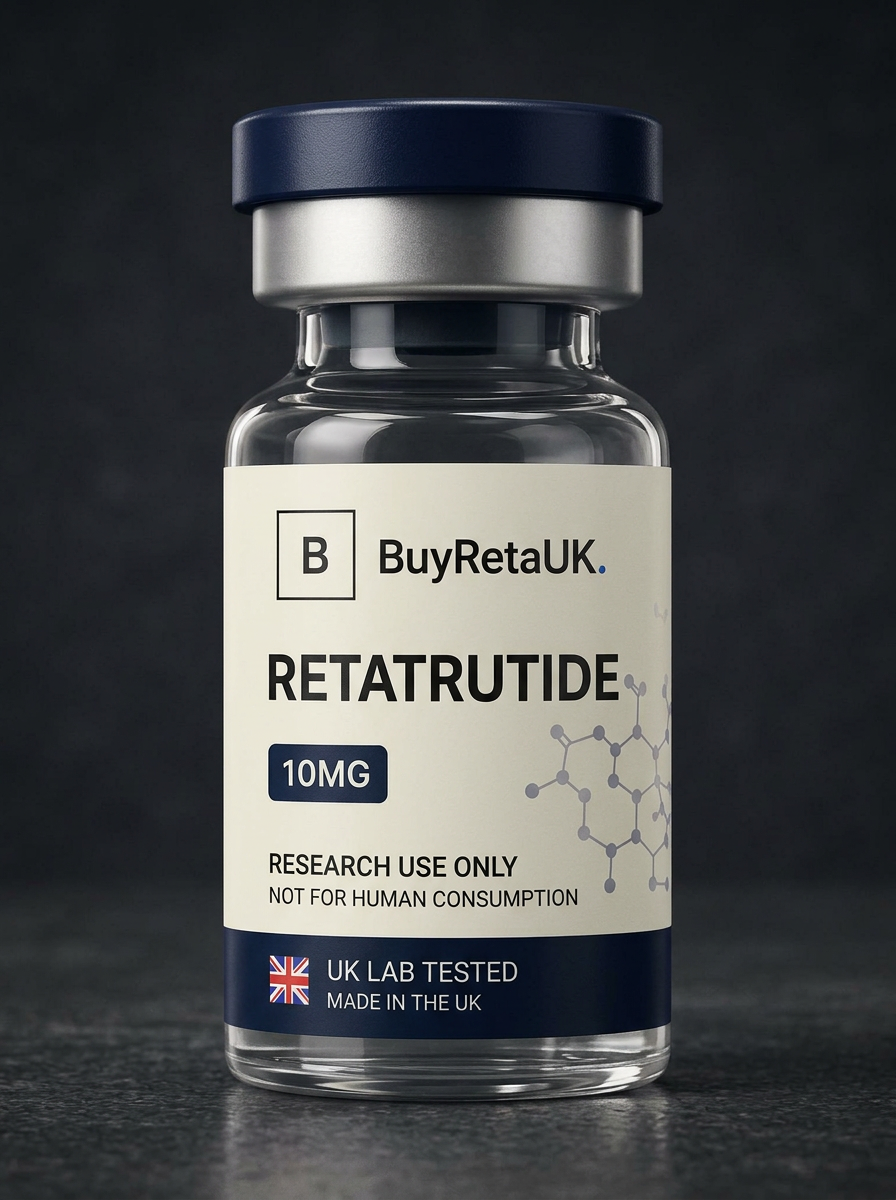
Retatrutide contains residues susceptible to photo-oxidation. Store vials in their original opaque or amber packaging, keep the refrigerator or freezer door closed, and minimise bench time under direct light during preparation. When photography or imaging of a vial is required, capture it briefly and return the vial to storage.
Moisture management is equally important. Ambient humidity condenses on cold glass, and opening a straight-from-the-fridge vial pulls that moisture directly onto the lyophilised cake. Always equilibrate a sealed vial to room temperature before breaking the stopper seal, and reseal promptly after every access.
Storage after reconstitution.
Once reconstituted with bacteriostatic water, retatrutide moves from an inherently stable lyophilised state to a solution phase where degradation kinetics accelerate. The bacteriostatic preservative (benzyl alcohol) suppresses microbial growth but does not stop chemical degradation. Refrigerated at 2–8 °C, a reconstituted working stock is typically used within 30 days.
For longer projects, freeze single-use aliquots at −20 °C immediately after reconstitution. Compute your dose volumes with the reconstitution calculator before drawing the diluent — pre-planned volumes let you match aliquot size to a single experimental use and avoid repeated access to the parent vial.
Laboratory best practices.
- Receive vials into cold storage within the vendor-stated cold-chain window on arrival.
- Record batch number, receipt date and storage location in the laboratory inventory system.
- Equilibrate to room temperature before opening; add diluent gently down the vial wall.
- Aliquot working stock into single-use volumes; label each with batch, date and concentration.
- Store aliquots at −20 °C; return the parent vial to refrigeration or freezing immediately.
- Thaw one aliquot per experimental use on wet ice; discard any unused volume.
- Log temperature excursions and correlate against any anomalous assay results.
- Cross-check batch numbers on the vial against the published COA at every hand-off.
Common storage mistakes.
Product quality & stability.
BuyRetaUK releases every retatrutide batch at ≥99% HPLC-UV purity with mass-spectrometry identity confirmation before it enters temperature-controlled inventory. Onward dispatch runs from UK cold storage under cold-chain protocols. The full quality framework — release criteria, retained samples and supplier qualification — is documented on the laboratory quality page.
Quality standards.
Reverse-phase HPLC quantifies purity as a percentage of total peak area. Release specification: ≥99%.
Learn more →Certificate of AnalysisEvery batch ships with a batch-specific COA reporting identity, purity and appearance.
Learn more →Laboratory QualityIndependent third-party analysis, temperature-controlled UK storage and full batch traceability.
Learn more →Batch VerificationCross-reference the batch number printed on your vial against our live COA library.
Learn more →Storage StandardsLyophilised at 2–8°C protected from light. Reconstituted stability ~30 days at 2–8°C.
Learn more →Certificate of Analysis considerations.
The Certificate of Analysis captures a batch at release — identity, purity, appearance and, where determined, endotoxin data. It is not a live stability record. Storage practice from the point of receipt onwards determines whether a specific vial continues to reflect its released specification.
Cross-reference the batch number printed on the vial against the corresponding COA in the verification library before any critical study, and read the section-by-section Certificate of Analysis guide for interpretation.
Buying considerations.
- Confirm cold storage capacity first
Verify refrigerator and freezer availability before ordering — cold-chain integrity starts the moment the parcel arrives.
- Order to project scope
Right-size vial strength and quantity to your study timeline to minimise long-term storage windows.
- Plan reconstitution in advance
Pre-compute diluent volumes and aliquot counts with the reconstitution calculator before any vial is opened.
- Standardise diluent supply
Stock bacteriostatic water alongside retatrutide for consistent reconstitution across batches.
FAQs.
What is the correct storage temperature for Retatrutide?[+]
Sealed, lyophilised Retatrutide vials are stored at 2–8 °C for short-to-medium term inventory and at −20 °C for long-term storage beyond three months. Both ranges must be protected from light and moisture.
Can Retatrutide be frozen?[+]
Yes — lyophilised Retatrutide is stable at −20 °C and this is the preferred long-term storage temperature. Reconstituted working stock can also be frozen when aliquoted; avoid repeated freeze-thaw cycles of the same aliquot.
How long is reconstituted Retatrutide stable?[+]
Held refrigerated at 2–8 °C in bacteriostatic water, the reconstituted working stock is typically used within 30 days. Frozen aliquots at −20 °C extend usable life but should still be minimised to a single thaw per aliquot.
Does Retatrutide need to be protected from light?[+]
Yes. Peptides are sensitive to photo-oxidation, particularly at residues such as tryptophan, tyrosine and methionine. Store vials in their original packaging, in a dark refrigerator or freezer, and minimise bench light exposure during handling.
How many freeze-thaw cycles can Retatrutide tolerate?[+]
There is no exact universal number — every cycle risks incremental degradation. Best practice is to aliquot reconstituted working stock immediately after preparation so each aliquot is thawed once and then discarded.
Do I need to equilibrate a cold vial before opening?[+]
Yes. Allow the sealed vial to reach room temperature before breaking the stopper seal. Opening a cold vial pulls humid ambient air onto the peptide cake, introducing moisture that can compromise stability.
Where should Retatrutide be stored in the lab?[+]
In a dedicated peptide-storage refrigerator or −20 °C freezer with stable temperature control, ideally with an alarm on out-of-range excursions. Avoid frost-free freezers that cycle temperature aggressively.
How does storage affect the batch COA?[+]
The Certificate of Analysis reflects the batch at release. Post-release stability depends on your local handling — poor storage will not be captured on the COA but can degrade the peptide relative to the released specification.
Scientific sources & further reading.
- [1]United States Pharmacopeia (2023) General Chapter <1503> Quality Attributes of Synthetic Peptide Drug Substances. USP-NF
- [2]ICH Harmonised Guideline (2003) Q1A(R2) Stability Testing of New Drug Substances and Products. International Council for Harmonisation
- [3]ICH Harmonised Guideline (1999) Q6A Specifications: Test Procedures and Acceptance Criteria for New Drug Substances and New Drug Products. International Council for Harmonisation
- [4]Manning M.C. et al. (2010) Stability of protein pharmaceuticals: an update. Pharmaceutical Research, 27(4) DOI: 10.1007/s11095-009-0045-6DOI →
- [5]Coskun T. et al. (2022) LY3437943, a novel triple GIP, GLP-1 and glucagon receptor agonist. Cell Metabolism, 34(9) DOI: 10.1016/j.cmet.2022.07.013DOI →
Peer-reviewed citations are added as each article is expanded. See our editorial standards for our sourcing and accuracy commitments.
Every editorial article is reviewed against our accuracy commitment and quality-assurance checklist before publication. Named reviewer profiles are added as our reviewer network expands.
View profile →How this content is produced.
Every article follows a documented editorial process — sourcing, scientific review, update cadence and correction policy — so researchers can rely on what we publish.
Read the full editorial standards →Your research-to-checkout journey.
Educational first. Each step is optional — start wherever you are in your research.
- Step 1ResearchUnderstand mechanism, class and study context.
- Step 2ComparisonSee how compounds differ in receptor profile.
- Step 3Laboratory qualityHPLC-UV purity, mass-spec identity, endotoxin data.
- Step 4Certificates of analysisVerify your batch in the public COA library.
- Step 5ProductsChoose a strength — every vial ships with COA.
- Step 6CheckoutEncrypted checkout, temperature-controlled UK dispatch.
How to research this topic.
Recommended reading path
- Step 01Start here — What is Retatrutide?
Compound overview, receptor profile and research framing.
- Step 02Compare with Tirzepatide
Triple vs dual incretin agonist — how they differ.
- Step 03Compare with Semaglutide
Triple agonist vs single GLP-1 agonist.
- Step 04Understand Certificates of Analysis
How to verify identity, purity and batch quality.
- Step 05Browse Retatrutide products
Every retatrutide variant with lab data.
- Step 06Calculate reconstitution
Solvent volume and dose-per-unit calculator.
Retatrutide at a glance.
Topic overview
- Retatrutide
- GLP-1
- GIP
- Glucagon
- Triple Agonist
- Incretin
Compare research compounds.
Triple vs dual incretin agonist — receptor profile and research framing.
View comparison →Side by sideTriple agonist vs single GLP-1 — class, mechanism and lab context.
View comparison →Multi-compoundAll GLP-1 / GIP / glucagon research compounds in one place.
View comparison →Related reference reading.
How to store lyophilised research peptides and reconstitute them correctly for laboratory use.
4 min read →Purity & Laboratory TestingThe quality standards BuyRetaUK applies to every batch — sourcing, analytical testing, storage and traceability.
5 min read →RetatrutideA laboratory overview of retatrutide (LY3437943) — a triple agonist research peptide acting on the GLP-1, GIP and glucagon receptors.
6 min read →RetatrutideBackground on retatrutide in the academic literature — receptor pharmacology, study context and analytical handling.
8 min read →Explore related collections.
Research guides, comparisons and laboratory reference material.
Browse collection →CollectionThe UK commercial hub for research-grade Retatrutide — lab data, COAs and dispatch.
Browse collection →CollectionThe full retatrutide range with research context and lab data.
Browse collection →Retatrutide & storage essentials.
Frequently researched together.
Certificate of Analysis.
Every batch of Retatrutide ships with a third-party HPLC and mass-spec Certificate of Analysis. Browse the live COA library to verify your lot.
Tools & resources.
Frequently asked questions.
Can lyophilised vials be frozen?
Long-term frozen storage (-20°C) is acceptable for lyophilised vials, but routine refrigerated storage at 2–8°C is sufficient for typical research timelines.
Read: Storage & Reconstitution →Is retatrutide approved for human use?
No. Retatrutide is supplied strictly for laboratory research and is not approved for human or veterinary administration.
Read: What is Retatrutide? →What receptors does retatrutide act on?
In published research it has been characterised as a triple agonist acting on the GLP-1, GIP and glucagon receptors.
Read: What is Retatrutide? →How should retatrutide be stored?
Lyophilised vials are stored at 2–8°C, protected from light. Once reconstituted with bacteriostatic water, store refrigerated and use within 30 days.
Read: What is Retatrutide? →Continue your research.
The UK laboratory reference for research-grade Retatrutide.
Read reference →ToolReconstitution calculatorConvert vial strength and target concentration to a diluent volume.
Open calculator →VerificationCertificate libraryCross-reference your batch number against the public COA library.
Open library →