For laboratory research use only · Not for human consumptionFree UK next-day delivery
Knowledge journey

Where this sits in the Retatrutide cluster.

Knowledge journey

  1. collectionGLP-1 Research
  2. collectionRetatrutide Collection
  3. guideWhat is Retatrutide?
  4. guideRetatrutide Mechanism of Action
  5. commercialRetatrutide UK
  6. comparisonRetatrutide vs Tirzepatide
  7. comparisonRetatrutide vs Semaglutide
  8. coaCertificate of Analysis Guide
  9. guideUnderstanding HPLC
  10. productBuy Retatrutide
Product reference · UK laboratory supply

Retatrutide 5mg.

A UK laboratory reference for the Retatrutide 5 mg research presentation — where a 5 mg vial fits in study design, how it compares to higher-strength presentations, and the batch quality, HPLC purity and storage standards that apply.

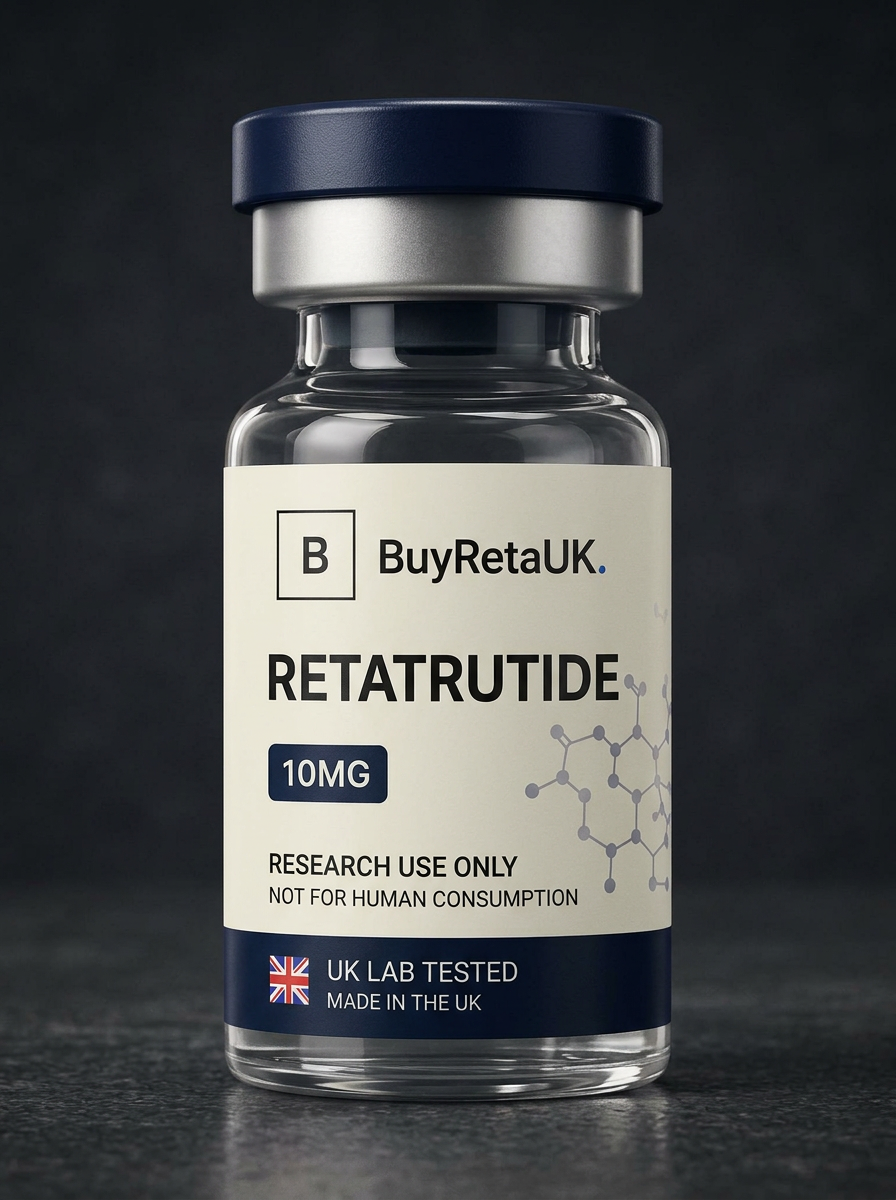
BuyRetaUK Retatrutide research peptide vial — 5 mg laboratory presentation reference
Published
June 2026
Last reviewed
June 2026
Next review
December 2026
Version
v1.1
Reading time
7 min read
Reviewed by
BuyRetaUK Scientific Review Team
Editorial team
BuyRetaUK Editorial Team
Review status
Scientific review complete
Quick summary

Quick summary

Retatrutide 5 mg refers to a 5-milligram lyophilised vial presentation. BuyRetaUK stocks 10 mg upward; researchers targeting a 5 mg equivalent typically reconstitute a 10 mg vial and adjust volume to match the intended working concentration.

Quick answer

In short.

Retatrutide 5 mg refers to a 5-milligram lyophilised vial presentation. BuyRetaUK stocks 10 mg upward; researchers targeting a 5 mg equivalent typically reconstitute a 10 mg vial and adjust volume to match the intended working concentration.
Key facts

At a glance.

Compound
Retatrutide (LY3437943)
Presentation
Lyophilised powder, sealed glass vial
Discussed strength
5 mg per vial
Available at BuyRetaUK
10 mg · 20 mg · 30 mg · 40 mg
Class
Triple receptor agonist research peptide
Receptor targets
GLP-1 · GIP · Glucagon
Release purity
≥99% HPLC-UV
Identity
Mass spectrometry confirmed
Documentation
Batch-specific Certificate of Analysis
Intended use
In-vitro laboratory research only
Definitions

Key terms.

Vial strength
The total mass of active peptide in a single lyophilised vial before reconstitution — for example 5 mg, 10 mg or 20 mg.
Working concentration
The peptide concentration in the reconstituted solution, set by the mass in the vial and the diluent volume added.
Reconstitution
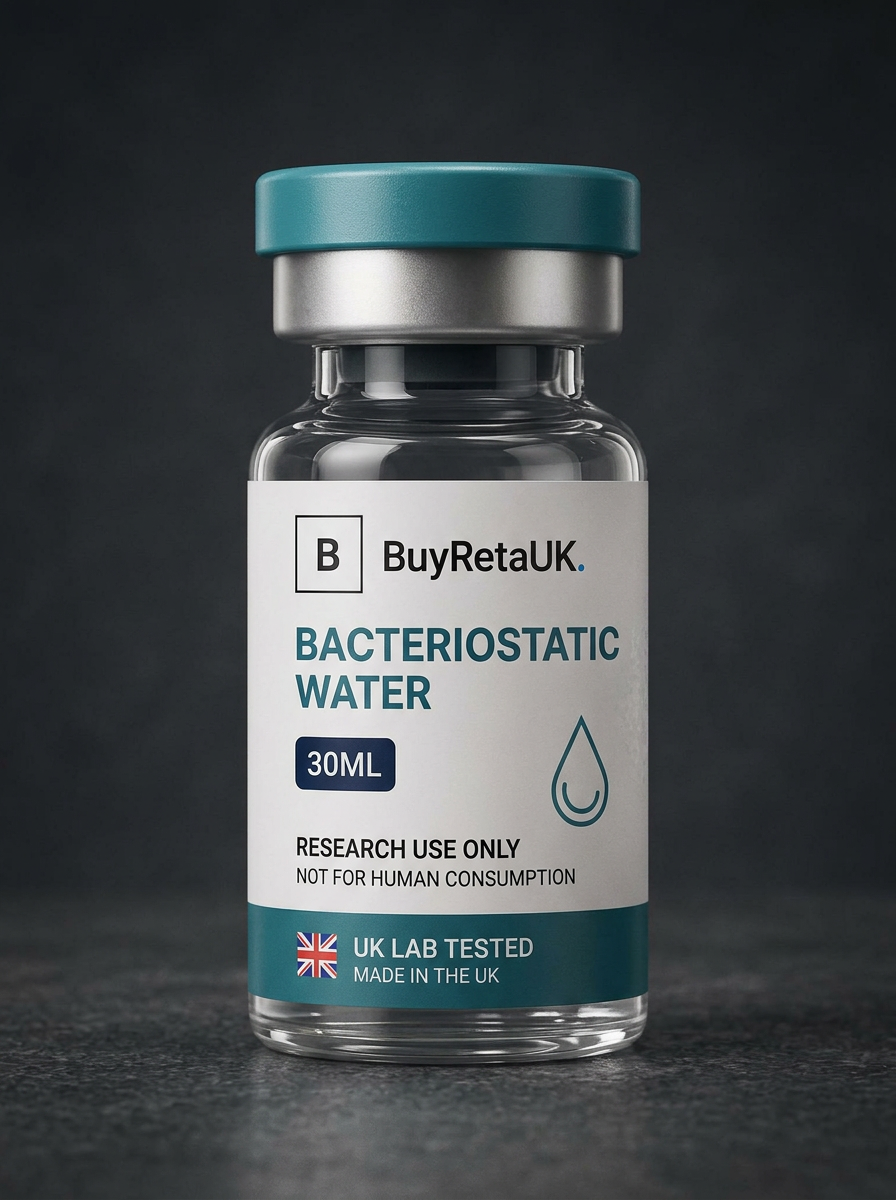
The controlled addition of a diluent (typically bacteriostatic water) to a lyophilised vial to produce a working stock at a defined concentration.
Aliquot
A single-use portion of reconstituted working stock, prepared and frozen individually to avoid repeated freeze-thaw of the parent vial.
Cold chain
The unbroken sequence of temperature-controlled handling steps that maintain a peptide within its validated storage range from release through end use.
Overview

What is Retatrutide 5 mg?

Retatrutide 5 mg refers to a lyophilised research-peptide vial containing 5 milligrams of Retatrutide (LY3437943), a synthetic triple receptor agonist under active investigation at the GLP-1, GIP and glucagon receptors. A 5 mg presentation sits toward the lower end of typical research vial strengths and is often selected for short, exploratory experiments where a small, defined mass of peptide is preferred over a larger vial that would require extensive aliquoting.

For a full compound overview — mechanism, receptor pharmacology and where Retatrutide fits within the broader incretin research landscape — see the cornerstone What is Retatrutide? guide.
Applications

Typical laboratory applications.

A 5 mg presentation is a practical fit for the following in-vitro research formats:

  • Short-duration receptor binding and functional assays with defined, low-volume dosing schedules.
  • Initial dose-ranging experiments prior to committing to larger-scale study runs.
  • Comparative studies against related GLP-1 / GIP / glucagon peptides where equal, small-mass aliquots simplify head-to-head design.
  • Cellular assays limited by well volume where only micrograms of peptide are consumed per plate.
  • Method development, chromatography reference and analytical standardisation work.

For larger, longer or replicate-heavy studies, higher-strength vials — 10 mg, 20 mg, 30 mg or 40 mg — usually offer better per-milligram economics with the same release specification.

Selection guidance

Why choose a 5 mg presentation?

Reduced storage overhead
Smaller inventory footprint in cold storage; suitable where cold-chain capacity is constrained.
Lower per-vial cost
Absolute vial price is lower than higher-strength presentations; useful for short-term projects with defined scope.
Minimised waste
For studies that consume only milligrams, a smaller vial reduces the risk of degrading unused stock over time.
Simplified aliquoting
Fewer aliquots per vial reduces handling steps and downstream freeze-thaw exposure.
Cleaner comparative design
Multiple identical low-mass vials support parallel, side-by-side experiments with matched conditions.

BuyRetaUK currently ships Retatrutide in 10 mg, 20 mg, 30 mg and 40 mg vials. Where a 5 mg working quantity is required, a 10 mg vial can be reconstituted and aliquoted into two 5 mg equivalents using the reconstitution calculator.

Choose your dose

Available strengths.

Every vial ships with a batch-specific COA · UK dispatch

Specifications

Product specifications.

Compound
Retatrutide (LY3437943)
Presentation
Lyophilised powder in sealed glass vial
Referenced strength
5 mg per vial (planning reference)
Stocked strengths
10 mg · 20 mg · 30 mg · 40 mg
Appearance
White to off-white lyophilised cake
Purity (release)
≥99% by HPLC-UV
Identity
Mass spectrometry confirmed (ESI-MS)
Reconstitution diluent
Bacteriostatic water for injection
Short-term storage
2–8 °C, protected from light
Long-term storage
−20 °C, sealed, protected from light
Documentation
Batch-specific Certificate of Analysis
Intended use
In-vitro laboratory research only
Batch quality

Batch quality & certificates of analysis.

Every Retatrutide vial — regardless of strength — is released against the same analytical specification: ≥99% HPLC-UV purity with mass-spectrometric identity confirmation, appearance check and, where applicable, moisture and endotoxin reporting. Each batch resolves to a unique batch number printed on the vial label, cross-referenced against a batch-specific Certificate of Analysis in the public verification library.

For a section-by-section walk-through of the Certificate of Analysis and how to interpret each field, read the Certificate of Analysis guide.

Purity

HPLC & purity.

Reversed-phase HPLC-UV is the primary release method for Retatrutide purity. The area-percent value at 214 nm quantifies the fraction of the total UV-detectable signal corresponding to the target peak; orthogonal mass spectrometry confirms identity. Together they define the release specification that every 5 mg-equivalent working quantity inherits.

For a complete explainer — chromatography theory, method parameters, how to read the impurity profile — see the Retatrutide Purity reference.

Storage

Storage guidance.

  • Store sealed lyophilised vials at 2–8 °C for short-to-medium term inventory.
  • For extended storage beyond three months, hold at −20 °C, sealed and protected from light.
  • Equilibrate cold vials to room temperature before opening to avoid moisture condensation on the peptide cake.
  • Reconstitute with bacteriostatic water; refrigerate the working stock at 2–8 °C and use within 30 days.
  • Aliquot into single-use portions immediately after reconstitution; thaw each aliquot once and discard unused volume.

For the full handling framework — refrigeration, freeze-thaw, light and moisture protection, common mistakes — see the Retatrutide Storage guide.

Laboratory quality

Quality standards.

Before you buy

Buying considerations.

  • Right-size to study scope

    Match vial strength to your total study consumption; smaller vials suit short exploratory work, larger vials suit sustained programmes.

  • Plan the reconstitution

    Pre-compute diluent volumes and aliquot counts with the reconstitution calculator before opening a new vial.

  • Confirm the batch documentation

    Cross-check the batch number on the vial label against the corresponding Certificate of Analysis in the verification library.

  • Prepare cold storage in advance

    Ensure temperature-controlled storage is available on receipt — the cold chain begins the moment the parcel arrives.

FAQs

Frequently asked questions.

Does BuyRetaUK stock a 5 mg Retatrutide vial?[+]

The current BuyRetaUK Retatrutide range is supplied in 10 mg, 20 mg, 30 mg and 40 mg presentations. A 5 mg strength is discussed here as a laboratory-planning reference. Researchers who need approximately 5 mg per experiment can prepare that mass by aliquoting a reconstituted 10 mg vial.

Is 5 mg an appropriate strength for in-vitro research?[+]

Yes — 5 mg is a reasonable working quantity for many short-format in-vitro studies. The right strength depends on the assay concentration, target volume and expected number of uses; the reconstitution calculator translates vial strength into diluent volume for a chosen working concentration.

How does a 5 mg vial compare to a 10 mg vial?[+]

A 10 mg vial produces twice the peptide mass at the same purity and quality specification. It is more cost-efficient per milligram but requires careful aliquoting to avoid repeated freeze-thaw. For short studies, a smaller vial reduces waste; for larger programmes, a higher strength typically wins on per-milligram cost.

What is the release purity for Retatrutide at BuyRetaUK?[+]

All Retatrutide vials — irrespective of strength — are released at ≥99% HPLC-UV purity, with identity confirmed by mass spectrometry and a batch-specific Certificate of Analysis published in the public verification library.

How should a Retatrutide vial be stored?[+]

Sealed lyophilised vials are held at 2–8 °C for short-to-medium term and at −20 °C for long-term storage. Once reconstituted, keep the working stock refrigerated at 2–8 °C and use within 30 days; aliquot for freezer storage if the study runs longer. Full guidance is in the Retatrutide storage guide.

Can a 5 mg working stock be prepared from a higher-strength vial?[+]

Yes. Reconstituting a 10 mg vial with 2 mL of bacteriostatic water produces a 5 mg/mL solution; alternative diluent volumes yield different concentrations. The reconstitution calculator handles the maths for any target concentration.

Is Retatrutide 5 mg suitable for human or veterinary use?[+]

No. Every Retatrutide vial supplied by BuyRetaUK — including any presentation strength — is for in-vitro laboratory research only and is not intended for human or veterinary administration.

References

Scientific sources & further reading.

  1. [1]Coskun T. et al. (2022) LY3437943, a novel triple GIP, GLP-1 and glucagon receptor agonist. Cell Metabolism, 34(9) DOI: 10.1016/j.cmet.2022.07.013DOI →
  2. [2]Jastreboff A.M. et al. (2023) Triple-hormone-receptor agonist Retatrutide for obesity — a Phase 2 trial. New England Journal of Medicine, 389(6) DOI: 10.1056/NEJMoa2301972DOI →
  3. [3]United States Pharmacopeia (2023) General Chapter <1503> Quality Attributes of Synthetic Peptide Drug Substances. USP-NF
  4. [4]ICH Harmonised Guideline (1999) Q6A Specifications: Test Procedures and Acceptance Criteria for New Drug Substances and New Drug Products. International Council for Harmonisation
  5. [5]ICH Harmonised Guideline (2003) Q1A(R2) Stability Testing of New Drug Substances and Products. International Council for Harmonisation

Peer-reviewed citations are added as each article is expanded. See our editorial standards for our sourcing and accuracy commitments.

Editorial team
BuyRetaUK Editorial Team
Author · BuyRetaUK

The BuyRetaUK editorial team publishes laboratory-focused reference content on research peptides, analytical methods and Certificates of Analysis. All articles are written for in-vitro research contexts only.

View profile →
Scientific reviewer
BuyRetaUK Scientific Review Team
Scientific reviewer

Every editorial article is reviewed against our accuracy commitment and quality-assurance checklist before publication. Named reviewer profiles are added as our reviewer network expands.

View profile →
Editorial standards

How this content is produced.

Every article follows a documented editorial process — sourcing, scientific review, update cadence and correction policy — so researchers can rely on what we publish.

Read the full editorial standards →
Commercial journey

Your research-to-checkout journey.

Educational first. Each step is optional — start wherever you are in your research.

  1. Step 1ResearchUnderstand mechanism, class and study context.
  2. Step 2ComparisonSee how compounds differ in receptor profile.
  3. Step 3Laboratory qualityHPLC-UV purity, mass-spec identity, endotoxin data.
  4. Step 4Certificates of analysisVerify your batch in the public COA library.
  5. Step 5ProductsChoose a strength — every vial ships with COA.
  6. Step 6CheckoutEncrypted checkout, temperature-controlled UK dispatch.
Recommended reading path

How to research this topic.

Recommended reading path

  1. Step 01
    Start here — What is Retatrutide?

    Compound overview, receptor profile and research framing.

  2. Step 02
    Compare with Tirzepatide

    Triple vs dual incretin agonist — how they differ.

  3. Step 03
    Compare with Semaglutide

    Triple agonist vs single GLP-1 agonist.

  4. Step 04
    Understand Certificates of Analysis

    How to verify identity, purity and batch quality.

  5. Step 05
    Browse Retatrutide products

    Every retatrutide variant with lab data.

  6. Step 06
    Calculate reconstitution

    Solvent volume and dose-per-unit calculator.

Topic overview

Retatrutide at a glance.

Topic overview

Comparisons
Knowledge Hub
Collections
Shop
Common pairings

Frequently researched together.

Batch verification

Every batch of Retatrutide ships with a third-party HPLC and mass-spec Certificate of Analysis. Browse the live COA library to verify your lot.

Research tools
FAQ
Can lyophilised vials be frozen?

Long-term frozen storage (-20°C) is acceptable for lyophilised vials, but routine refrigerated storage at 2–8°C is sufficient for typical research timelines.

Read: Storage & Reconstitution
Is retatrutide approved for human use?

No. Retatrutide is supplied strictly for laboratory research and is not approved for human or veterinary administration.

Read: What is Retatrutide?
What receptors does retatrutide act on?

In published research it has been characterised as a triple agonist acting on the GLP-1, GIP and glucagon receptors.

Read: What is Retatrutide?
How should retatrutide be stored?

Lyophilised vials are stored at 2–8°C, protected from light. Once reconstituted with bacteriostatic water, store refrigerated and use within 30 days.

Read: What is Retatrutide?
Next steps

Continue your research.