The BuyRetaUK editorial team publishes laboratory-focused reference content on research peptides, analytical methods and Certificates of Analysis. All articles are written for in-vitro research contexts only.
View profile →Where this sits in the Semaglutide cluster.
Knowledge journey
- collectionGLP-1 Research
- commercialSemaglutide UK
- guideWhat is Semaglutide?
- guideSemaglutide Mechanism of Action
- guideSemaglutide Research
- guideSemaglutide Clinical Trials
- guideSemaglutide Purity
- guideSemaglutide Storage
- comparisonSemaglutide vs Tirzepatide
- collectionSemaglutide catalogue
- productBuy Semaglutide
- comparisonRetatrutide vs Semaglutide
Semaglutide storage & reconstitution.
The BuyRetaUK laboratory handling reference for Semaglutide (NN9535) — how to store the lyophilised vial, how to reconstitute with bacteriostatic water, and how to preserve the released ≥99% HPLC-UV specification through the working life of the reconstituted stock.
- Batch-specific COA available
- Laboratory research use only
- Independent third-party testing
- UK dispatch
- Secure checkout

- Published
- July 2026
- Last reviewed
- July 2026
- Next review
- December 2026
- Version
- v1.1
- Reading time
- 9 min read
- Reviewed by
- BuyRetaUK Scientific Review Team
- Editorial team
- BuyRetaUK Editorial Team
- Review status
- Scientific review complete
Quick summary
Lyophilised Semaglutide (NN9535) is stored sealed at −20 °C, protected from light and moisture. It is reconstituted with bacteriostatic water (0.9% benzyl alcohol) at a volume that yields the target working concentration, then held at 2–8 °C and typically used within four to six weeks. Freeze-thaw cycling of reconstituted stock should be avoided, and every vial should be labelled with date, diluent, concentration and batch number.
In short.
At a glance.
- Compound
- Semaglutide (NN9535)
- Form as supplied
- White to off-white lyophilised powder
- Long-term storage
- −20 °C, sealed, desiccated, dark
- Short-term (weeks)
- 2–8 °C in original sealed vial
- Ambient exposure
- Minimise; permit only for brief handling
- Preferred diluent
- Bacteriostatic water for injection (0.9% benzyl alcohol)
- Post-reconstitution storage
- 2–8 °C, upright, protected from light
- Typical in-use window
- 4–6 weeks refrigerated (lab reference)
- Freeze-thaw of reconstituted stock
- Avoid; single-use aliquots preferred if freezing required
- Container orientation
- Upright — reduces closure-liner contact
- Intended use
- In-vitro laboratory research only
Key handling terms for Semaglutide.
- Lyophilisation
- Freeze-drying — sublimation of water under vacuum to yield a dry Semaglutide cake that is chemically far more stable than the aqueous form.
- Bacteriostatic water (BAC)
- Sterile water for injection containing 0.9% benzyl alcohol as a preservative — the standard laboratory diluent for reconstituting Semaglutide intended for multi-day refrigerated use.
- Reconstitution
- The controlled addition of a defined diluent volume to the Semaglutide vial to yield a solution of known concentration for downstream laboratory work.
- Cold chain
- The continuous refrigerated / frozen handling path from manufacture through dispatch and receipt that protects the released Semaglutide specification from thermal excursion.
- Thermal excursion
- Any departure from the specified storage temperature range. Brief excursions during handling are tolerated; repeated or extended excursions accelerate peptide degradation.
- Freeze-thaw cycle
- One complete transition of a reconstituted Semaglutide aliquot between the frozen and thawed states — each cycle imposes mechanical and chemical stress on the peptide.
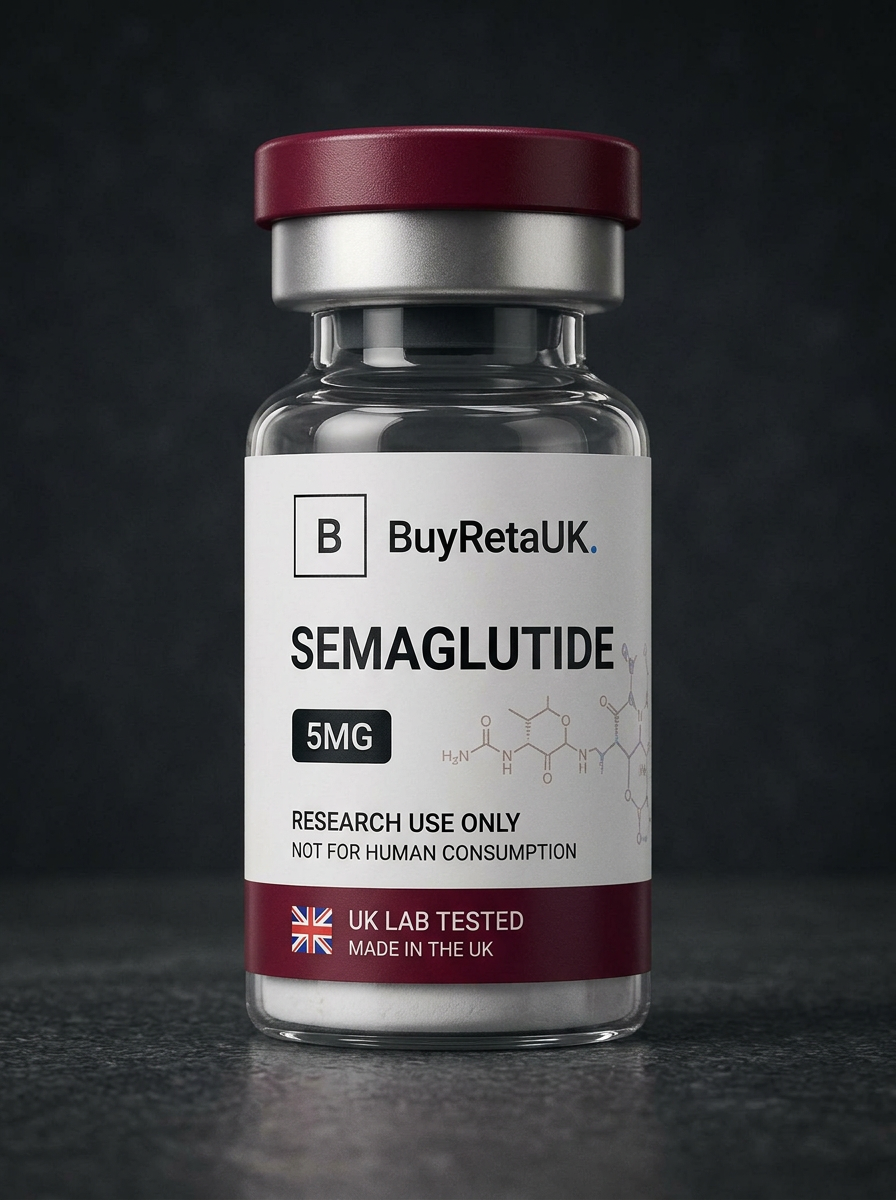
Semaglutide storage overview.
Semaglutide (NN9535) is supplied as a lyophilised powder because the dry state is far more chemically stable than the aqueous form. The purpose of laboratory storage is to preserve the batch in the condition documented on its release Certificate of Analysis until it reaches the bench — which means protecting the vial from moisture ingress, from prolonged thermal excursion and from light.
Semaglutide's lipidated Lys26 side-chain and Aib8 substitution give the peptide its long half-life in solution but do not remove its susceptibility to slow oxidation and deamidation. The analytical view of what the release specification means lives on the Semaglutide purity page; handling detail is kept here so those pages remain focused.
Recommended storage conditions.
| Form | Temperature | Environment | Typical window |
|---|---|---|---|
| Lyophilised, sealed vial | −20 °C | Dark, dry, desiccated, upright | Long-term storage |
| Lyophilised, sealed vial | 2–8 °C | Dark, dry, sealed | Short-term working stock |
| Lyophilised, sealed vial | Ambient (≈15–25 °C) | Brief handling only | Minutes — not for storage |
| Reconstituted in BAC | 2–8 °C | Upright, dark, sealed | 4–6 weeks (lab reference) |
| Reconstituted, single-use aliquots | ≤ −20 °C | One freeze cycle only | Extended storage |
Where a Semaglutide batch Certificate of Analysis reports specific stability data, the batch-level record takes precedence over this general laboratory reference.
Temperature guidance.
Chemical degradation of Semaglutide is strongly temperature-dependent. Lower temperatures suppress the hydrolytic, oxidative and deamidation pathways that drive slow drift in NN9535 quality. A lyophilised vial held at −20 °C therefore ages far more slowly than the same vial held at ambient temperature. Short handling excursions are expected and tolerated; repeated or extended excursions are a documented cause of post-release degradation.
Always allow a frozen Semaglutide vial to equilibrate to room temperature before opening. Opening a cold vial straight into humid room air draws atmospheric moisture onto the lyophilised cake — one of the most avoidable causes of quality loss for a lipidated GLP-1 analogue.
Refrigeration.
A dedicated laboratory refrigerator at 2–8 °C with monitored temperature and controlled access is the appropriate short-term store for Semaglutide working vials and reconstituted stock. Consumer refrigerators are poorly temperature-stable — door-shelf swings of 5–10 °C on every opening are common — and are not suitable for a research peptide. Keep vials upright, away from the door, and in original packaging where possible.
Freeze / thaw considerations.
Lyophilised Semaglutide tolerates long-term frozen storage well — the powder is glassy and chemically inert relative to its aqueous counterpart. Reconstituted Semaglutide is different: repeated freeze-thaw cycling stresses the peptide mechanically through ice-crystal formation and chemically through pH shifts and localised concentration effects as water freezes out. If extended storage of reconstituted material is unavoidable, aliquot at reconstitution into single-use volumes and freeze each aliquot exactly once.
Light and moisture protection.
Store Semaglutide vials in the dark. Ultraviolet and short-wavelength visible light drive slow oxidation of photolabile residues and should be excluded during storage. Keep vials sealed until use — lyophilised Semaglutide is hygroscopic, and moisture ingress leads to cake caking, colour change and accelerated degradation. Retain the original desiccant where supplied and discard any vial whose seal integrity is in doubt.
Lyophilised handling.
A well-formed Semaglutide lyophilised cake is uniform, white to off-white and occupies its expected volume in the vial. Cake collapse, meltback, discoloration or a wet appearance indicate that the batch has experienced thermal or moisture stress and should not be used without escalation. Do not tap or shake a lyophilised vial to break the cake — inspect it visually and reconstitute directly.
Semaglutide reconstitution overview.
Reconstitution converts the lyophilised Semaglutide vial into a working solution of known concentration. The variables are three: total mass in the vial (from the label and Certificate of Analysis), diluent identity and diluent volume. Choose the diluent volume to give a working concentration that suits the downstream study — the reconstitution calculator returns the exact solvent volume for any target concentration and vial strength.
Technique matters. Draw the calculated diluent volume, add it slowly against the inner wall of the vial rather than directly onto the Semaglutide cake, and swirl gently until fully dissolved. Do not shake or vortex — mechanical stress promotes aggregation of lipidated GLP-1 analogues. Once dissolved, the Semaglutide solution should be clear and colourless.
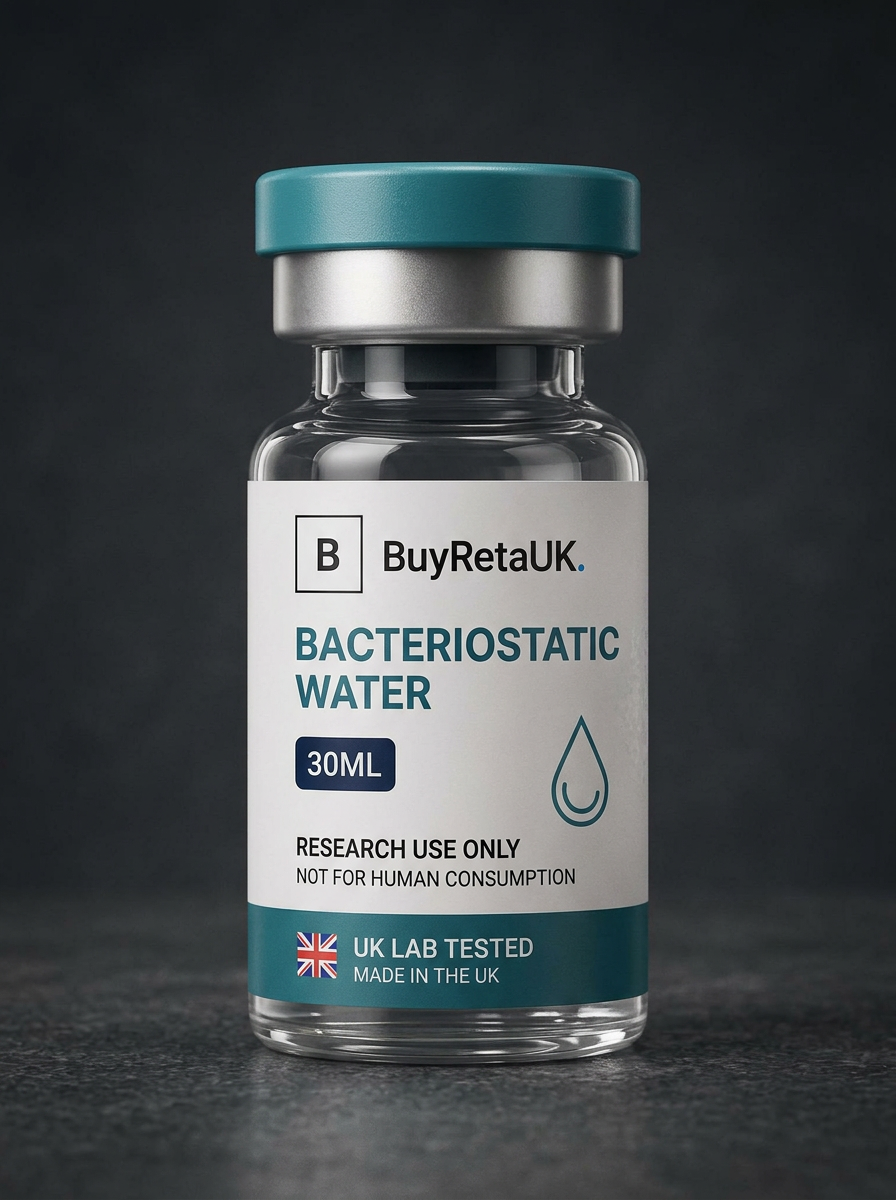
Bacteriostatic water.
Bacteriostatic water for injection contains 0.9% benzyl alcohol as a preservative. The preservative suppresses microbial growth in a multi-use Semaglutide vial and supports refrigerated in-use stability over several weeks. Preservative-free sterile water for injection is acceptable for same-day preparations only; any Semaglutide workflow that keeps the reconstituted vial for more than 24 hours should default to bacteriostatic water.
Semaglutide storage after reconstitution.
Store the reconstituted Semaglutide vial at 2–8 °C, upright and protected from light. As a general laboratory reference, Semaglutide reconstituted in bacteriostatic water is used within four to six weeks. Label the vial at reconstitution with the date, diluent, resulting concentration and batch number so the in-use history is fully traceable back to the released analytical record.
Any change in visual appearance — precipitate, cloudiness, colour drift — should stop use of the vial until the anomaly is resolved against the batch Certificate of Analysis.
Common Semaglutide handling mistakes.
Semaglutide laboratory best practices.
- Store lyophilised Semaglutide vials at −20 °C in original packaging, protected from light and moisture.
- Allow frozen vials to equilibrate to room temperature before opening.
- Inspect the Semaglutide lyophilised cake visually before reconstitution — colour, uniformity, seal integrity.
- Reconstitute with bacteriostatic water for any workflow that spans more than a single day.
- Add diluent against the inner wall of the vial and swirl gently — never vortex or shake vigorously.
- Use the reconstitution calculator to convert Semaglutide vial strength into a defined working concentration.
- Label every reconstituted Semaglutide vial with date, diluent, resulting concentration and batch number.
- Refrigerate reconstituted stock at 2–8 °C; avoid freeze-thaw cycling.
- Discard any vial whose cake or solution appearance departs from specification, and escalate to the supplier.
Laboratory quality.
Semaglutide storage and reconstitution sit inside the broader quality framework described on the laboratory quality page, referenced against USP General Chapters <797> and <1503>, ICH Q1A(R2) for stability testing and ICH Q5C for biological-product stability. The WHO Technical Report Series 961 Annex 9 framework informs cold-chain expectations for time- and temperature-sensitive materials.
Quality standards.
Reverse-phase HPLC quantifies purity as a percentage of total peak area. Release specification: ≥99%.
Learn more →Certificate of AnalysisEvery batch ships with a batch-specific COA reporting identity, purity and appearance.
Learn more →Laboratory QualityIndependent third-party analysis, temperature-controlled UK storage and full batch traceability.
Learn more →Batch VerificationCross-reference the batch number printed on your vial against our live COA library.
Learn more →Storage StandardsLyophilised at 2–8°C protected from light. Reconstituted stability ~30 days at 2–8°C.
Learn more →COA considerations.
The Semaglutide Certificate of Analysis records the batch at release. Where a batch COA reports specific stability data — recommended storage temperature, retest date, in-use limits — that batch-level record takes precedence over any general laboratory reference. The full anatomy of a COA is covered in the Certificate of Analysis guide. Confirm your vial's batch number in the verification library before opening.
Buying considerations.
- Confirm cold-chain dispatch for Semaglutide
Insulated packaging and a documented dispatch temperature protect the released ≥99% HPLC-UV specification in transit.
- Match diluent to workflow
Choose bacteriostatic water for multi-day laboratory Semaglutide use; keep preservative-free sterile water for same-day preparations.
- Buy Semaglutide stock that fits the study
Reconstituted Semaglutide has a finite in-use life — size purchases to consumption within the refrigerated stability window.
- Verify the Semaglutide batch before opening
Cross-reference the vial batch number against the public COA library on arrival — provenance starts before the seal is broken.
Frequently asked questions.
How should lyophilised Semaglutide be stored long-term?[+]
Sealed in its original vial at −20 °C, protected from light and moisture, with desiccant and outer packaging intact. Only remove from the freezer immediately before use, and equilibrate to room temperature before opening so atmospheric moisture cannot condense onto the lyophilised cake.
Can lyophilised Semaglutide be kept at 2–8 °C?[+]
Yes for short-term working stock — typically a few weeks — provided the vial remains sealed, upright and dark. For long-term storage before reconstitution, −20 °C is preferred because it slows the hydrolytic and oxidative pathways that drive slow chemical change in NN9535.
Which diluent is used to reconstitute Semaglutide?[+]
Bacteriostatic water for injection (sterile water containing 0.9% benzyl alcohol) is the standard laboratory diluent. The preservative supports refrigerated in-use stability across multiple days. Preservative-free sterile water is acceptable for same-day use only.
How is the reconstitution volume chosen?[+]
Chosen to give a convenient working concentration for the downstream study. A 5 mg Semaglutide vial reconstituted in 1 mL yields 5 mg/mL; 2 mL yields 2.5 mg/mL. The BuyRetaUK reconstitution calculator returns the exact solvent volume for any target concentration.
How long is reconstituted Semaglutide stable?[+]
As a laboratory reference, reconstituted Semaglutide in bacteriostatic water is stored at 2–8 °C and used within four to six weeks. Where a batch Certificate of Analysis reports specific in-use stability data, the batch-level record takes precedence.
Should reconstituted Semaglutide be frozen?[+]
Repeated freeze-thaw cycling is discouraged — each cycle imposes ice-crystal and pH stress on the peptide. If long storage is unavoidable, aliquot at reconstitution into single-use volumes and freeze each aliquot once at −20 °C or below.
What is the correct reconstitution technique for Semaglutide?[+]
Draw the calculated diluent volume, add it slowly against the inner wall of the vial rather than directly onto the lyophilised cake, then swirl gently until the cake is fully dissolved. Do not shake or vortex — mechanical stress promotes aggregation of lipidated GLP-1 analogues.
How does Semaglutide storage relate to its purity?[+]
The purity value on the Certificate of Analysis is a release-time measurement. Post-release thermal excursion, moisture ingress or freeze-thaw of reconstituted stock can drive degradation that reduces effective purity — the vial in your hand may no longer match the number on its COA.
Scientific sources & further reading.
- [1]United States Pharmacopeia (2023) General Chapter <797> Pharmaceutical Compounding — Sterile Preparations. USP-NF
- [2]United States Pharmacopeia (2023) General Chapter <1503> Quality Attributes of Synthetic Peptide Drug Substances. USP-NF
- [3]ICH Harmonised Tripartite Guideline (2003) Q1A(R2) Stability Testing of New Drug Substances and Products. International Council for Harmonisation
- [4]ICH Harmonised Tripartite Guideline (1995) Q5C Stability Testing of Biotechnological / Biological Products. International Council for Harmonisation
- [5]World Health Organization (2011) Annex 9 — Model guidance for the storage and transport of time- and temperature-sensitive pharmaceutical products. WHO Technical Report Series 961
- [6]Manning M.C., Chou D.K., Murphy B.M., Payne R.W., Katayama D.S. (2010) Stability of protein pharmaceuticals: an update. Pharmaceutical Research, 27(4) DOI: 10.1007/s11095-009-0045-6DOI →
- [7]Lau J. et al. (2015) Discovery of the once-weekly glucagon-like peptide-1 (GLP-1) analogue semaglutide. Journal of Medicinal Chemistry, 58(18): 7370–7380 DOI: 10.1021/acs.jmedchem.5b00726DOI →
- What is Semaglutide? — cornerstone guide
- Semaglutide Research
- Semaglutide Mechanism of Action
- Semaglutide Purity
- Semaglutide UK — commercial hub
- Semaglutide catalogue
- Certificate of Analysis guide
- Storage & Reconstitution — general guide
- Laboratory quality
- Verification library (COAs)
- Reconstitution calculator
- Editorial standards
Peer-reviewed citations are added as each article is expanded. See our editorial standards for our sourcing and accuracy commitments.
Every editorial article is reviewed against our accuracy commitment and quality-assurance checklist before publication. Named reviewer profiles are added as our reviewer network expands.
View profile →How this content is produced.
Every article follows a documented editorial process — sourcing, scientific review, update cadence and correction policy — so researchers can rely on what we publish.
Read the full editorial standards →Your research-to-checkout journey.
Educational first. Each step is optional — start wherever you are in your research.
- Step 1ResearchUnderstand mechanism, class and study context.
- Step 2ComparisonSee how compounds differ in receptor profile.
- Step 3Laboratory qualityHPLC-UV purity, mass-spec identity, endotoxin data.
- Step 4Certificates of analysisVerify your batch in the public COA library.
- Step 5ProductsChoose a strength — every vial ships with COA.
- Step 6CheckoutEncrypted checkout, temperature-controlled UK dispatch.
How to research this topic.
Recommended reading path
- Step 01Start here — What is Semaglutide?
Compound overview, receptor profile and research framing.
- Step 02Mechanism of action
GLP-1 receptor engagement, Gαs / cAMP signalling and single-agonist pharmacology.
- Step 03Research landscape
Published laboratory evidence, discovery lineage and research applications.
- Step 04Clinical trial evidence
SUSTAIN, STEP and SELECT — published Phase 3 evidence summary.
- Step 05Purity
HPLC-UV release, mass-spec identity and batch verification for Semaglutide.
- Step 06Storage & reconstitution
Lyophilised handling, bacteriostatic water reconstitution and in-use stability for Semaglutide.
- Step 07Semaglutide vs Tirzepatide
Selective GLP-1 receptor agonist vs dual GIP/GLP-1 agonist — balanced scientific comparison.
- Step 08Commercial hub — Semaglutide UK
Research-grade semaglutide with batch-specific COA.
Semaglutide at a glance.
Topic overview
- Semaglutide
- NN9535
- Tirzepatide
- LY3298176
- GLP-1
- GLP-1 Receptor
- GLP-1 Receptor Agonist
- GIP
- GIP Receptor
- Dual Agonist
- Incretin
- STEP
- SUSTAIN
- SELECT
- PIONEER
- SURPASS
- SURMOUNT
- Clinical Evidence
- HPLC
- Mass Spectrometry
- COA
- Storage
- Reconstitution
- Bacteriostatic Water
Compare research compounds.
Triple agonist vs single GLP-1 — class, mechanism and lab context.
View comparison →Side by sideSelective GLP-1 agonist vs dual GIP/GLP-1 agonist — receptor pharmacology and evidence comparison.
View comparison →Multi-compoundAll GLP-1 / GIP / glucagon research compounds in one place.
View comparison →Related reference reading.
How to store lyophilised research peptides and reconstitute them correctly for laboratory use.
4 min read →Purity & Laboratory TestingThe quality standards BuyRetaUK applies to every batch — sourcing, analytical testing, storage and traceability.
5 min read →RetatrutideA laboratory overview of retatrutide (LY3437943) — a triple agonist research peptide acting on the GLP-1, GIP and glucagon receptors.
6 min read →RetatrutideBackground on retatrutide in the academic literature — receptor pharmacology, study context and analytical handling.
8 min read →Explore related collections.
Research guides, comparisons and laboratory reference material.
Browse collection →CollectionThe UK commercial hub for research-grade Retatrutide — lab data, COAs and dispatch.
Browse collection →CollectionThe full retatrutide range with research context and lab data.
Browse collection →Research-grade Semaglutide & essentials.
Frequently researched together.
Certificate of Analysis.
Every batch of Semaglutide ships with a third-party HPLC and mass-spec Certificate of Analysis. Browse the live COA library to verify your lot.
Tools & resources.
Frequently asked questions.
Can lyophilised vials be frozen?
Long-term frozen storage (-20°C) is acceptable for lyophilised vials, but routine refrigerated storage at 2–8°C is sufficient for typical research timelines.
Read: Storage & Reconstitution →Why is retatrutide of interest to researchers?
Its simultaneous activity at three incretin-related receptors makes it a useful tool compound for probing combined signalling pathways in metabolic research.
Read: Retatrutide Research Overview →Where can I view BuyRetaUK COAs?
All current batch certificates are listed on our verification page and linked from each product.
Read: Understanding Certificates of Analysis →What purity should I expect?
Our research peptides are released at ≥99% HPLC purity unless otherwise stated on the product listing.
Read: Understanding Certificates of Analysis →Continue your research.
HPLC-UV release specification and batch verification for NN9535.
Read reference →MechanismSemaglutide Mechanism of ActionSelective GLP-1 receptor pharmacology and Gαs / cAMP signalling.
Read mechanism →ToolReconstitution calculatorConvert Semaglutide vial strength into a defined working concentration.
Open calculator →