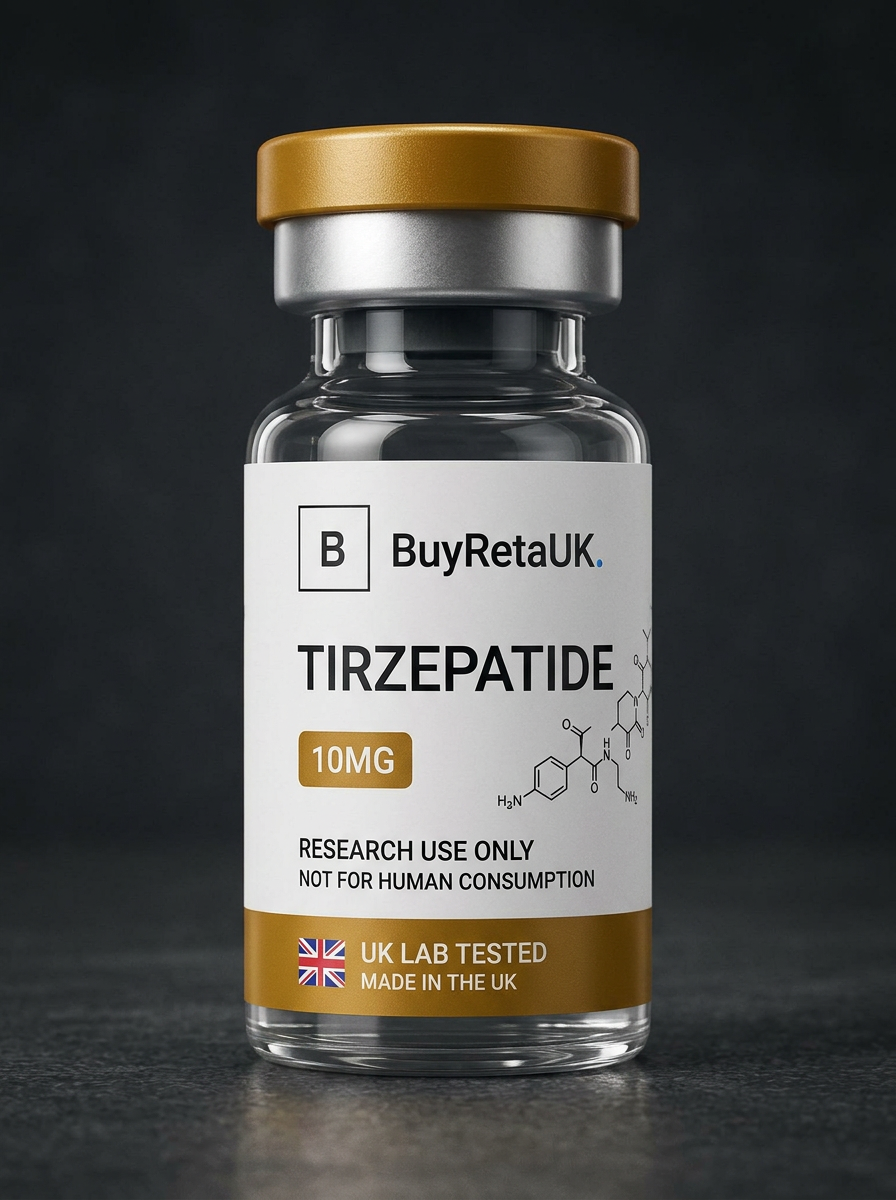
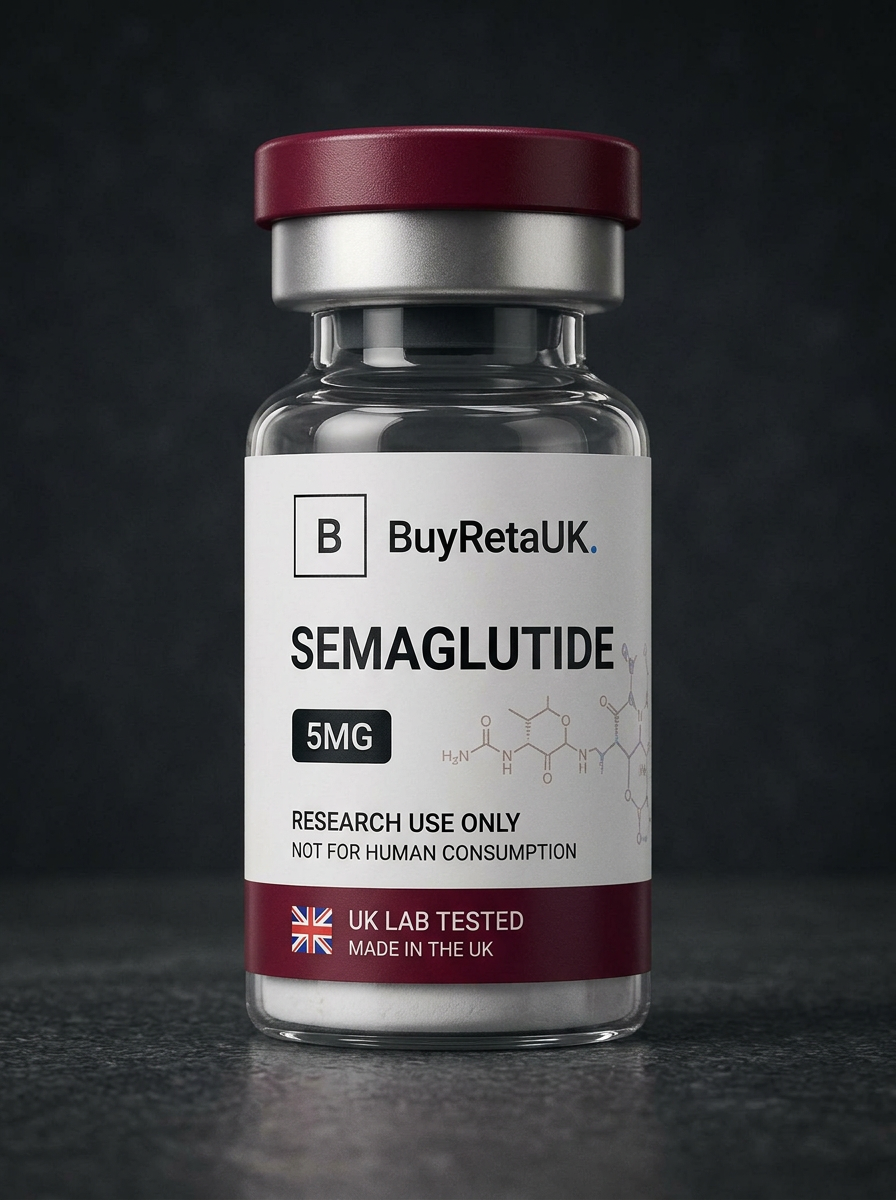
The BuyRetaUK editorial team publishes laboratory-focused reference content on research peptides, analytical methods and Certificates of Analysis. All articles are written for in-vitro research contexts only.
View profile →Where this sits in the Retatrutide cluster.
Knowledge journey
Retatrutide strengths.
Parent hub for Retatrutide vial strengths: 10 mg, 20 mg, 30 mg and 40 mg lyophilised research peptide. Compare presentations, working concentrations and reconstitution volumes at a glance.
- Batch-specific COA available
- Laboratory research use only
- Independent third-party testing
- UK dispatch
- Secure checkout

- Published
- June 2026
- Last reviewed
- June 2026
- Next review
- December 2026
- Version
- v1.1
- Reading time
- 9 min read
- Reviewed by
- BuyRetaUK Scientific Review Team
- Editorial team
- BuyRetaUK Editorial Team
- Review status
- Scientific review complete
In short.
At a glance.
- Compound
- Retatrutide (LY3437943)
- Available strengths
- 10 mg · 20 mg · 30 mg · 40 mg
- Presentation
- Lyophilised powder in sealed glass vial
- Release purity
- ≥99% HPLC-UV, per batch
- Identity confirmation
- Mass spectrometry (ESI-MS)
- Documentation
- Batch-specific Certificate of Analysis
- Reconstitution
- Bacteriostatic water; volume set at the bench
- Storage (lyophilised)
- 2–8 °C short-term, −20 °C long-term
- Verification
- Public COA library indexed by batch number
- Intended use
- In-vitro laboratory research only
Key terms.
- Vial strength
- The total mass of lyophilised peptide contained in a single sealed vial, before reconstitution. Independent of concentration, which is set at the point of reconstitution.
- Working concentration
- The concentration of peptide in the reconstituted solution, expressed in mg/mL. Determined jointly by vial strength and reconstitution volume.
- Reconstitution volume
- The volume of bacteriostatic water added to the vial. Chosen to produce the target working concentration for the planned workflow.
- Batch
- A single manufacturing lot with its own analytical release record. Every BuyRetaUK vial carries a batch identifier that resolves to the batch COA.
- Lyophilised
- Freeze-dried into a stable solid cake; the standard presentation for research peptides prior to reconstitution.
- COA (Certificate of Analysis)
- The batch release document reporting identity, HPLC-UV purity, appearance and, where determined, moisture and endotoxin.
Available Retatrutide strengths.
BuyRetaUK supplies Retatrutide (LY3437943) in four lyophilised vial strengths: 10 mg, 20 mg, 30 mg and 40 mg. Each strength is manufactured under a single release framework, tested by reversed-phase HPLC-UV for purity and ESI-MS for identity, and released against the same ≥99% area-percent specification. The strength on the vial defines the total peptide mass; the working concentration is set at the bench by choosing an appropriate reconstitution volume.
Every batch resolves to a batch-specific Certificate of Analysis in the public verification library, indexed by the batch number printed on the vial label. Strength selection is therefore independent of quality — quality is invariant across the four strengths — and is driven by laboratory planning considerations covered below.
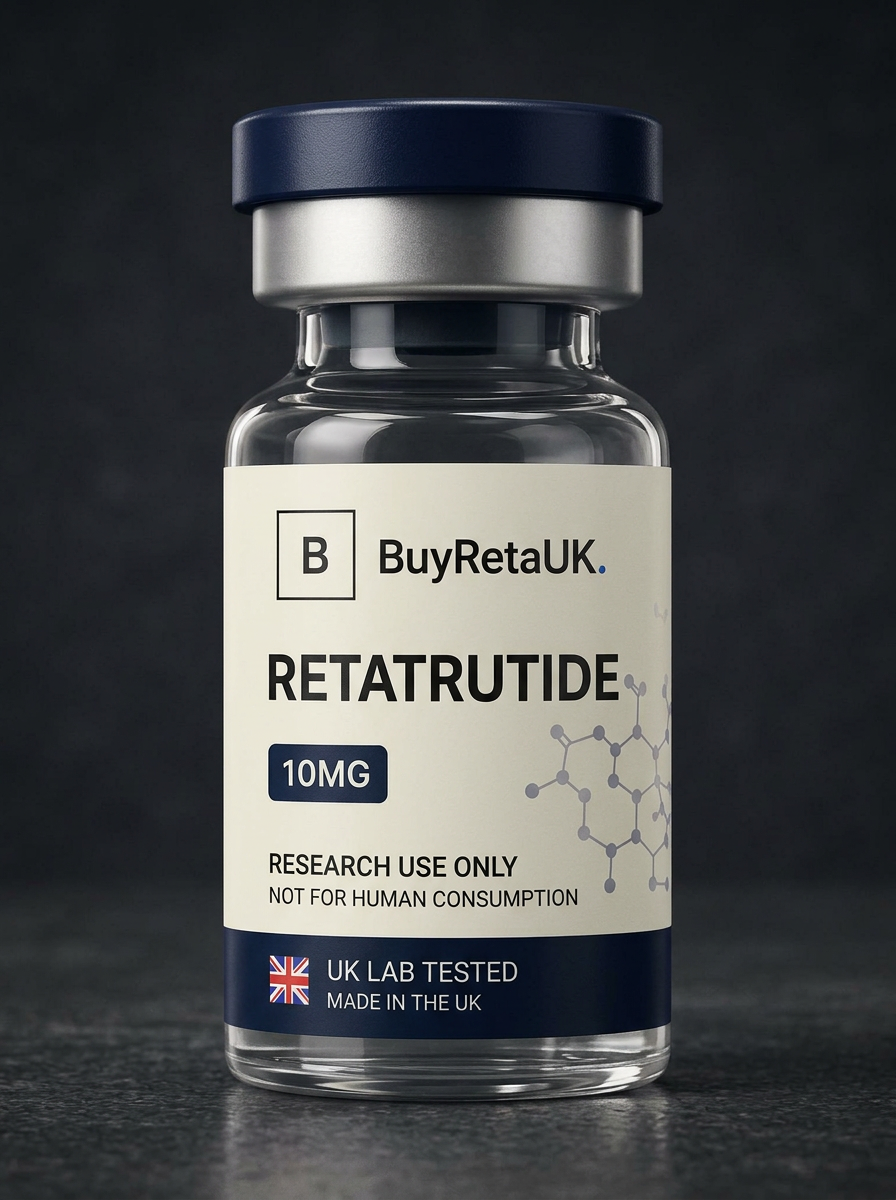
Available strengths.
Every vial ships with a batch-specific COA · UK dispatch
Choosing the appropriate strength.
Strength selection is a planning decision, not a dosage recommendation. The relevant inputs are the total peptide mass a protocol requires, the reconstitution volume the laboratory prefers to standardise on, and the working concentration needed at the bench. Because working concentration is a function of vial strength divided by reconstitution volume, several combinations can produce the same result — the reconstitution calculator translates strength and volume into concentration for any target workflow.
- Total mass required. Match the vial to your programme's mass requirement to minimise batch fragmentation.
- Freeze-thaw exposure. Larger reconstituted volumes may be aliquoted to reduce freeze-thaw cycles per aliquot.
- Consumption rate. Reconstituted working solution has a finite handling window — align vial strength with realistic usage.
- Batch reconciliation. Fewer, larger batches simplify batch-to-batch reconciliation across a study.
Handling of reconstituted material — refrigeration windows, freeze-thaw limits and light exposure — is covered in the Retatrutide storage guide.
Strength comparison table.
| Strength | Price | Profile | Laboratory note |
|---|---|---|---|
| 10 mg | £59 | Entry-strength vial for short workflows or method-development runs where a small total mass is preferred. | Smaller reconstitution volumes deliver higher working concentrations from a single vial. |
| 20 mg | £90 | Mid-range vial suited to routine multi-well or multi-plate laboratory experimentation. | Balances working-solution longevity with reduced freeze-thaw exposure per vial. |
| 30 mg | £110 | Extended-run vial for longer studies or larger reconstitution volumes. | Well-suited to laboratories standardising on a single reconstitution volume across multiple experiments. |
| 40 mg | £145 | Highest available strength for sustained workflows and larger-scale in-vitro programmes. | Consolidates a research programme onto fewer batches, simplifying batch-to-batch reconciliation. |
All strengths share the same ≥99% HPLC-UV release specification and batch-specific Certificate of Analysis. Prices are per vial and subject to change; confirm on the product page.
Which Retatrutide strength fits your workflow?
| Research scenario | Recommended | Rationale |
|---|---|---|
| Entry-strength vial for short workflows or method-development runs where a small total mass is preferred. | Retatrutide 10 mg — £59 | Smaller reconstitution volumes deliver higher working concentrations from a single vial. |
| Mid-range vial suited to routine multi-well or multi-plate laboratory experimentation. | Retatrutide 20 mg — £90 | Balances working-solution longevity with reduced freeze-thaw exposure per vial. |
| Extended-run vial for longer studies or larger reconstitution volumes. | Retatrutide 30 mg — £110 | Well-suited to laboratories standardising on a single reconstitution volume across multiple experiments. |
| Highest available strength for sustained workflows and larger-scale in-vitro programmes. | Retatrutide 40 mg — £145 | Consolidates a research programme onto fewer batches, simplifying batch-to-batch reconciliation. |
Consistent quality across every strength.
Regardless of strength, every BuyRetaUK Retatrutide vial is manufactured to the same synthesis and release framework. Release testing combines reversed-phase HPLC-UV for purity, ESI-MS for identity, and — where relevant — Karl Fischer moisture determination and endotoxin testing. The methodology and acceptance criteria are documented on the laboratory quality page.
Quality standards.
Reverse-phase HPLC quantifies purity as a percentage of total peak area. Release specification: ≥99%.
Learn more →Certificate of AnalysisEvery batch ships with a batch-specific COA reporting identity, purity and appearance.
Learn more →Laboratory QualityIndependent third-party analysis, temperature-controlled UK storage and full batch traceability.
Learn more →Batch VerificationCross-reference the batch number printed on your vial against our live COA library.
Learn more →Storage StandardsLyophilised at 2–8°C protected from light. Reconstituted stability ~30 days at 2–8°C.
Learn more →Certificates of Analysis.
Every vial — 10 mg through 40 mg — is released with a batch-specific Certificate of Analysis that reports identity, HPLC-UV purity, appearance and, where determined, moisture and endotoxin. Batch numbers on the vial label resolve to their COA in the public verification library. The anatomy of a COA — section by section — is covered in the Certificate of Analysis guide.
HPLC-UV purity, verified per batch.
Purity is the analytically determined fraction of the target peptide in a batch, measured by reversed-phase HPLC with UV detection at 214 nm and expressed as area-percent. BuyRetaUK Retatrutide is released at ≥99% area-percent HPLC-UV, with identity confirmed independently by mass spectrometry. Method deep-dive, chromatography parameters and interpretation guidance are covered on the Retatrutide purity page.
Storage across all strengths.
Storage requirements do not vary by vial strength. Lyophilised Retatrutide is stable at 2–8 °C in the short term and at −20 °C for longer-term retention; reconstituted working solution is refrigerated and consumed within a limited window with minimised freeze-thaw exposure. Full cold-chain handling and freeze-thaw guidance is documented in the Retatrutide storage guide.
Buying considerations.
- Match strength to programme mass
Choose the vial mass that covers your total workflow with the fewest batch changes.
- Standardise reconstitution volume
Fix a reconstitution volume across a study so working concentration scales predictably with strength.
- Confirm every batch COA
Regardless of strength, resolve the vial's batch number in the verification library before use.
- Plan aliquot strategy
Aliquot reconstituted material to minimise freeze-thaw cycles — larger vials benefit most from disciplined aliquoting.
Frequently asked questions.
What Retatrutide strengths does BuyRetaUK offer?[+]
BuyRetaUK supplies Retatrutide in four lyophilised vial strengths: 10 mg, 20 mg, 30 mg and 40 mg. All four share the same ≥99% HPLC-UV release specification and mass-spectrometric identity confirmation, and each ships with a batch-specific Certificate of Analysis.
Do smaller and larger vials differ in purity?[+]
No. Every Retatrutide strength is released against the same analytical specification. The vial label carries the batch number; the batch COA in the verification library documents the release purity and identity result.
How do I decide which strength to order?[+]
Strength selection is a laboratory-planning decision. Consider the total mass your protocol requires, the reconstitution volume you plan to use, the working concentration you need at the bench, and how quickly the reconstituted material will be consumed. The reconstitution calculator translates vial strength and volume into a concentration.
Does a larger vial change the working concentration?[+]
Not by itself. Working concentration is set by the ratio of vial strength to reconstitution volume. A 40 mg vial reconstituted in 4 mL produces the same concentration as a 10 mg vial reconstituted in 1 mL.
Is there a 5 mg strength?[+]
BuyRetaUK does not stock a dedicated 5 mg vial. Researchers requiring a 5 mg equivalent typically use a 10 mg vial and adjust the reconstitution volume accordingly. Details are in the Retatrutide 5 mg planning reference.
Are all strengths sourced from the same manufacturing programme?[+]
Yes. Every BuyRetaUK Retatrutide vial — regardless of strength — is produced under the same synthesis and release framework, with orthogonal HPLC-UV purity and mass-spectrometric identity testing.
How is each strength verified?[+]
Every vial carries a batch identifier that resolves to its Certificate of Analysis in the public verification library. Read the batch number, open the COA, and confirm the analytical release data before use.
Do larger vials store differently?[+]
No. Storage is governed by the physical form (lyophilised vs reconstituted) and environment, not by vial mass. The Retatrutide storage guide covers cold-chain handling and freeze-thaw considerations for all strengths.
Scientific sources & further reading.
- [1]Coskun T. et al. (2022) LY3437943, a novel triple GIP, GLP-1 and glucagon receptor agonist. Cell Metabolism, 34(9) DOI: 10.1016/j.cmet.2022.07.013DOI →
- [2]Jastreboff A.M. et al. (2023) Triple-Hormone-Receptor Agonist Retatrutide for Obesity — A Phase 2 Trial. New England Journal of Medicine, 389(6) DOI: 10.1056/NEJMoa2301972DOI →
- [3]United States Pharmacopeia (2023) General Chapter <1503> Quality Attributes of Synthetic Peptide Drug Substances. USP-NF
- [4]ICH Harmonised Guideline (1999) Q6A Specifications: Test Procedures and Acceptance Criteria for New Drug Substances and New Drug Products. International Council for Harmonisation
- [5]ICH Harmonised Guideline (2003) Q1A(R2) Stability Testing of New Drug Substances and Products. International Council for Harmonisation
- Retatrutide Research — laboratory reference
- Retatrutide Storage — handling and stability
- Retatrutide Purity — HPLC-UV & COA interpretation
- Retatrutide UK — commercial hub
- What is Retatrutide? — cornerstone guide
- Certificate of Analysis guide
- Laboratory quality standards
- Verification library (COAs)
- Reconstitution calculator
- Retatrutide 5 mg planning reference
- Retatrutide 10 mg — entry vial
- Retatrutide 20 mg — mid-range vial
- Retatrutide 30 mg — extended-run vial
- Retatrutide 40 mg — highest-strength vial
Peer-reviewed citations are added as each article is expanded. See our editorial standards for our sourcing and accuracy commitments.
Every editorial article is reviewed against our accuracy commitment and quality-assurance checklist before publication. Named reviewer profiles are added as our reviewer network expands.
View profile →How this content is produced.
Every article follows a documented editorial process — sourcing, scientific review, update cadence and correction policy — so researchers can rely on what we publish.
Read the full editorial standards →Your research-to-checkout journey.
Educational first. Each step is optional — start wherever you are in your research.
- Step 1ResearchUnderstand mechanism, class and study context.
- Step 2ComparisonSee how compounds differ in receptor profile.
- Step 3Laboratory qualityHPLC-UV purity, mass-spec identity, endotoxin data.
- Step 4Certificates of analysisVerify your batch in the public COA library.
- Step 5ProductsChoose a strength — every vial ships with COA.
- Step 6CheckoutEncrypted checkout, temperature-controlled UK dispatch.
How to research this topic.
Recommended reading path
- Step 01Start here — What is Retatrutide?
Compound overview, receptor profile and research framing.
- Step 02Compare with Tirzepatide
Triple vs dual incretin agonist — how they differ.
- Step 03Compare with Semaglutide
Triple agonist vs single GLP-1 agonist.
- Step 04Understand Certificates of Analysis
How to verify identity, purity and batch quality.
- Step 05Browse Retatrutide products
Every retatrutide variant with lab data.
- Step 06Calculate reconstitution
Solvent volume and dose-per-unit calculator.
Research-grade Retatrutide & essentials.
Compare research compounds.
Triple vs dual incretin agonist — receptor profile and research framing.
View comparison →Side by sideTriple agonist vs single GLP-1 — class, mechanism and lab context.
View comparison →Multi-compoundAll GLP-1 / GIP / glucagon research compounds in one place.
View comparison →Certificate of Analysis.
Every batch of Retatrutide ships with a third-party HPLC and mass-spec Certificate of Analysis. Browse the live COA library to verify your lot.
Continue your research.
The UK laboratory reference for research-grade Retatrutide.
Read reference →HandlingRetatrutide StorageCold-chain, freeze-thaw and reconstitution guidance for every strength.
Open storage guide →AnalyticalRetatrutide PurityHPLC-UV testing, batch verification and COA interpretation.
Open purity guide →