The BuyRetaUK editorial team publishes laboratory-focused reference content on research peptides, analytical methods and Certificates of Analysis. All articles are written for in-vitro research contexts only.
View profile →Where this sits in the Tirzepatide cluster.
Knowledge journey
- collectionGLP-1 Research
- commercialTirzepatide UK
- guideWhat is Tirzepatide?
- guideTirzepatide Mechanism of Action
- guideTirzepatide Research
- guideTirzepatide Clinical Trials
- collectionTirzepatide Collection
- collectionTirzepatide Strengths
- commercialTirzepatide 10mg
- commercialTirzepatide 20mg
- commercialTirzepatide 40mg
- comparisonRetatrutide vs Tirzepatide
- guideTirzepatide Storage
- guideTirzepatide Purity
- productBuy Tirzepatide
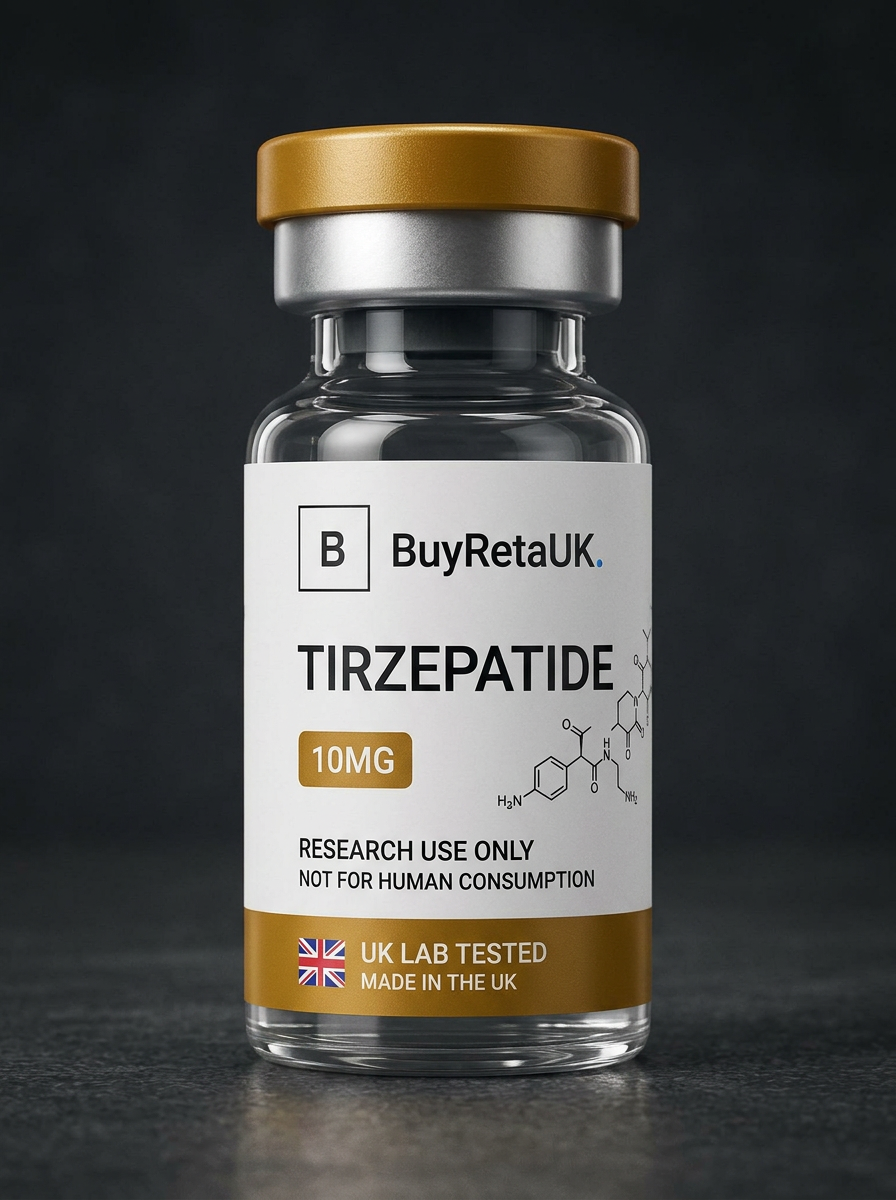
Tirzepatide 20mg vial.
Tirzepatide 20 mg is the mid-range lyophilised LY3298176 vial — the balanced, general-purpose presentation for routine BuyRetaUK laboratory programmes where a single reconstitution supports multi-well work at a manageable per-milligram cost.
- Batch-specific COA available
- Laboratory research use only
- Independent third-party testing
- UK dispatch
- Secure checkout

- Published
- June 2026
- Last reviewed
- June 2026
- Next review
- December 2026
- Version
- v1.1
- Reading time
- 7 min read
- Reviewed by
- BuyRetaUK Scientific Review Team
- Editorial team
- BuyRetaUK Editorial Team
- Review status
- Scientific review complete
Quick summary
Tirzepatide 20 mg is a 20-milligram lyophilised LY3298176 vial released to ≥99% HPLC-UV with mass-spectrometric identity. It is the mid-range presentation in the BuyRetaUK Tirzepatide catalogue — the default choice for routine, general-purpose laboratory programmes that outgrow the 10 mg pilot format.
In short.
At a glance.
- Compound
- Tirzepatide (LY3298176)
- Vial strength
- 20 mg per lyophilised vial
- Position in range
- Mid-range — sits between 10 mg and 40 mg
- Adjacent step down / up
- 10 mg (½ mass) · 40 mg (2× mass)
- Release purity
- ≥99% HPLC-UV area-percent
- Identity
- ESI-MS confirmed against LY3298176 theoretical mass
- Typical reconstitution
- 2 mL bacteriostatic water → 10 mg/mL working stock
- Documentation
- Batch-specific Certificate of Analysis
- Intended use
- In-vitro laboratory research only
Key terms.
- Mid-range vial
- The middle presentation in a peptide strength ladder — chosen when a protocol regularly consumes more than a single entry vial but does not warrant the largest stocked strength.
- Routine programme
- A recurring or ongoing laboratory workflow with predictable weekly or monthly peptide consumption, where batch consistency and workflow throughput matter more than absolute per-milligram cost.
- Working stock
- The reconstituted solution used directly in assays — its concentration is set by the ratio of vial mass to the added diluent volume.
- Per-milligram cost
- The vial price divided by its peptide mass in milligrams — a useful planning input when comparing strengths under an identical release specification.
What is Tirzepatide 20 mg?
Tirzepatide 20 mg is a single lyophilised vial containing 20 milligrams of Tirzepatide (LY3298176), a synthetic dual GLP-1 / GIP receptor agonist. It sits in the middle of the BuyRetaUK stocked strength ladder and is the routine, general-purpose choice for laboratory programmes that outgrow the 10 mg entry vial without yet needing the 40 mg extended presentation.
For pharmacology see Tirzepatide Mechanism of Action; for cornerstone reference material see What is Tirzepatide?.
When researchers choose the 20 mg vial.
20 mg vs 10 mg vs 40 mg.
Step down to the Tirzepatide 10 mg vial for pilot or method-development work; step up to the Tirzepatide 40 mg vial for sustained or higher-throughput programmes. Every stocked strength shares the same release specification — see the Strengths Hub for the full comparison table.
Available strengths.
Every vial ships with a batch-specific COA · UK dispatch
Product specifications.
- Compound
- Tirzepatide (LY3298176)
- Vial strength
- 20 mg
- Presentation
- Lyophilised powder in sealed glass vial
- Appearance
- White to off-white lyophilised cake
- Purity (release)
- ≥99% by HPLC-UV
- Identity
- ESI-MS confirmed
- Reconstitution diluent
- Bacteriostatic water for injection
- Short-term storage
- 2–8 °C, protected from light
- Long-term storage
- −20 °C, sealed, protected from light
- Documentation
- Batch-specific Certificate of Analysis
- Intended use
- In-vitro laboratory research only
Laboratory quality.
The 20 mg vial is released under the same synthesis and analytical framework as every other stocked Tirzepatide strength — see laboratory quality for methodology and acceptance criteria.
Quality standards.
Reverse-phase HPLC quantifies purity as a percentage of total peak area. Release specification: ≥99%.
Learn more →Certificate of AnalysisEvery batch ships with a batch-specific COA reporting identity, purity and appearance.
Learn more →Laboratory QualityIndependent third-party analysis, temperature-controlled UK storage and full batch traceability.
Learn more →Batch VerificationCross-reference the batch number printed on your vial against our live COA library.
Learn more →Storage StandardsLyophilised at 2–8°C protected from light. Reconstituted stability ~30 days at 2–8°C.
Learn more →Certificate of Analysis.
Every 20 mg vial ships with a batch-specific Certificate of Analysis. Cross-check the batch number against the verification library on arrival — the section-by-section walk-through lives in the Certificate of Analysis guide.
Purity.
The 20 mg vial is released against the same ≥99% HPLC-UV area-percent specification as every stocked strength, with orthogonal identity confirmation by ESI-MS. Method detail lives in Tirzepatide Purity.
Storage.
Store sealed 20 mg vials at −20 °C for extended holding, or at 2–8 °C for short-term working stock. Once reconstituted with bacteriostatic water, refrigerate the vial at 2–8 °C and consume within four to six weeks — a 20 mg reconstitution particularly benefits from an aliquot strategy set at reconstitution. Full guidance in Tirzepatide Storage & Reconstitution.
Buying considerations.
- Set an aliquot plan at reconstitution
A 20 mg reconstitution is worth aliquoting to keep freeze-thaw exposure per aliquot to a single cycle.
- Standardise reconstitution volume across studies
Fixing the volume across batches keeps working concentration comparable when a study spans multiple vials.
- Match order size to consumption rate
Order enough 20 mg vials to cover the study without over-committing shelf life.
- Verify every batch before use
Cross-reference each vial's batch number against the published Certificate of Analysis.
Frequently asked questions.
Why is 20 mg the default Tirzepatide vial for routine programmes?[+]
It carries enough peptide to serve most multi-well or multi-plate in-vitro workflows from a single reconstitution while remaining small enough that reconstituted stock is consumed within a sensible in-use window — the balance point of the stocked ladder.
How much working stock does a 20 mg Tirzepatide vial produce?[+]
Reconstituting a 20 mg vial in 2 mL of bacteriostatic water yields 10 mg/mL; in 4 mL yields 5 mg/mL; in 1 mL yields 20 mg/mL. The reconstitution calculator returns the exact diluent volume for any target working concentration.
How does 20 mg compare with the 10 mg entry vial?[+]
20 mg is twice the packaged mass at a lower per-milligram cost, so it typically becomes the right choice as soon as a protocol will consume more than one 10 mg vial. Both share the same ≥99% HPLC-UV release specification.
When is 40 mg the better choice over 20 mg?[+]
Choose 40 mg for sustained or higher-throughput programmes where per-milligram economics dominate, or where consolidating a workflow onto fewer batches simplifies batch-to-batch reconciliation. For general-purpose routine work, 20 mg is usually the balance point.
Does the 20 mg vial differ analytically from the 10 mg or 40 mg?[+]
No. Every stocked Tirzepatide vial is manufactured under the same synthesis and release framework, with identical HPLC-UV purity and ESI-MS identity confirmation reported on the batch-specific Certificate of Analysis.
What is a sensible aliquot strategy for a 20 mg vial?[+]
Reconstitute once, then split the working stock into single-use aliquots sized to the daily or weekly volume the protocol consumes, frozen once and thawed once. The Tirzepatide storage guide covers freeze-thaw handling in detail.
Is Tirzepatide 20 mg intended for human or veterinary use?[+]
No. All BuyRetaUK Tirzepatide vials, including the 20 mg vial, are supplied for in-vitro laboratory research only and are not intended for human or veterinary administration.
Scientific sources & further reading.
- [1]Coskun T. et al. (2018) LY3298176, a novel dual GIP and GLP-1 receptor agonist for the treatment of type 2 diabetes mellitus. Molecular Metabolism, 18 DOI: 10.1016/j.molmet.2018.09.009DOI →
- [2]Jastreboff A.M. et al. (2022) Tirzepatide once weekly for the treatment of obesity (SURMOUNT-1). New England Journal of Medicine, 387(3) DOI: 10.1056/NEJMoa2206038DOI →
- [3]United States Pharmacopeia (2023) General Chapter <1503> Quality Attributes of Synthetic Peptide Drug Substances. USP-NF
- [4]ICH Harmonised Guideline (1999) Q6A Specifications: Test Procedures and Acceptance Criteria for New Drug Substances. ICH
- Tirzepatide Strengths Hub — 10, 20, 40 mg
- Tirzepatide 10 mg — entry-tier vial
- Tirzepatide 40 mg — extended workflows
- Tirzepatide UK — commercial hub
- Tirzepatide catalogue
- What is Tirzepatide? — cornerstone
- Tirzepatide Research
- Tirzepatide Mechanism of Action
- Tirzepatide Purity
- Tirzepatide Storage & Reconstitution
- Certificate of Analysis guide
- Laboratory quality
- Verification library (COAs)
- Reconstitution calculator
Peer-reviewed citations are added as each article is expanded. See our editorial standards for our sourcing and accuracy commitments.
Every editorial article is reviewed against our accuracy commitment and quality-assurance checklist before publication. Named reviewer profiles are added as our reviewer network expands.
View profile →How this content is produced.
Every article follows a documented editorial process — sourcing, scientific review, update cadence and correction policy — so researchers can rely on what we publish.
Read the full editorial standards →Your research-to-checkout journey.
Educational first. Each step is optional — start wherever you are in your research.
- Step 1ResearchUnderstand mechanism, class and study context.
- Step 2ComparisonSee how compounds differ in receptor profile.
- Step 3Laboratory qualityHPLC-UV purity, mass-spec identity, endotoxin data.
- Step 4Certificates of analysisVerify your batch in the public COA library.
- Step 5ProductsChoose a strength — every vial ships with COA.
- Step 6CheckoutEncrypted checkout, temperature-controlled UK dispatch.
How to research this topic.
Recommended reading path
- Step 01Start here — What is Tirzepatide?
Dual GIP/GLP-1 receptor overview and research framing.
- Step 02Mechanism of action
How dual receptor engagement drives the incretin response.
- Step 03Research landscape
Published evidence base, SURPASS & SURMOUNT programmes, laboratory applications.
- Step 04Clinical trial evidence
Phase 3 SURPASS & SURMOUNT read-outs and the peer-reviewed literature.
- Step 05Compare with Retatrutide
Dual vs triple incretin agonist — how they differ.
- Step 06Verify a batch
HPLC purity and Certificate of Analysis verification.
- Step 07Storage & reconstitution
Lyophilised storage, bacteriostatic water reconstitution, in-use stability.
- Step 08Browse strengths
Every tirzepatide vial strength available.
- Step 09Buy tirzepatide
UK commercial hub — lab data, COAs and dispatch.
Tirzepatide at a glance.
Topic overview
- Tirzepatide
- LY3298176
- GLP-1
- GIP
- Dual Agonist
- Incretin
- SURPASS
- SURMOUNT
Compare research compounds.
Triple vs dual incretin agonist — receptor profile and research framing.
View comparison →Side by sideSelective GLP-1 agonist vs dual GIP/GLP-1 agonist — receptor pharmacology and evidence comparison.
View comparison →Multi-compoundAll GLP-1 / GIP / glucagon research compounds in one place.
View comparison →Related reference reading.
How to store lyophilised research peptides and reconstitute them correctly for laboratory use.
4 min read →RetatrutideA laboratory overview of retatrutide (LY3437943) — a triple agonist research peptide acting on the GLP-1, GIP and glucagon receptors.
6 min read →RetatrutideBackground on retatrutide in the academic literature — receptor pharmacology, study context and analytical handling.
8 min read →Product ComparisonsSide-by-side comparison of retatrutide and tirzepatide across receptor profile, research context and analytical considerations.
5 min read →Tirzepatide & related research products.
Frequently researched together.
Certificate of Analysis.
Every batch of Tirzepatide ships with a third-party HPLC and mass-spec Certificate of Analysis. Browse the live COA library to verify your lot.
Tools & resources.
Frequently asked questions.
Can lyophilised vials be frozen?
Long-term frozen storage (-20°C) is acceptable for lyophilised vials, but routine refrigerated storage at 2–8°C is sufficient for typical research timelines.
Read: Storage & Reconstitution →