The BuyRetaUK editorial team publishes laboratory-focused reference content on research peptides, analytical methods and Certificates of Analysis. All articles are written for in-vitro research contexts only.
View profile →Where this sits in the Tirzepatide cluster.
Knowledge journey
- collectionGLP-1 Research
- commercialTirzepatide UK
- guideWhat is Tirzepatide?
- guideTirzepatide Mechanism of Action
- guideTirzepatide Research
- guideTirzepatide Clinical Trials
- collectionTirzepatide Collection
- collectionTirzepatide Strengths
- commercialTirzepatide 10mg
- commercialTirzepatide 20mg
- commercialTirzepatide 40mg
- comparisonRetatrutide vs Tirzepatide
- guideTirzepatide Storage
- guideTirzepatide Purity
- productBuy Tirzepatide
Tirzepatide mechanism of action.
The BuyRetaUK scientific reference for how Tirzepatide (LY3298176) works — a single synthetic peptide that simultaneously activates the GLP-1 and GIP receptors, and what balanced dual incretin agonism means for laboratory research.
- Batch-specific COA available
- Laboratory research use only
- Independent third-party testing
- UK dispatch
- Secure checkout

- Published
- July 2026
- Last reviewed
- July 2026
- Next review
- December 2026
- Version
- v1.1
- Reading time
- 10 min read
- Reviewed by
- BuyRetaUK Scientific Review Team
- Editorial team
- BuyRetaUK Editorial Team
- Review status
- Scientific review complete
Quick summary
Tirzepatide is a synthetic 39-residue peptide that acts as a balanced dual agonist at the GIP and GLP-1 receptors — two class-B G-protein-coupled receptors that signal predominantly through Gαs and cyclic AMP. Simultaneous engagement of both incretin receptors distinguishes it from single-agonist (semaglutide) and triple-agonist (retatrutide) peptides.
In short.
At a glance.
- Compound
- Tirzepatide (LY3298176)
- Peptide length
- 39 amino-acid residues
- Receptor targets
- GIPR · GLP-1R
- Receptor class
- Class B secretin-family GPCRs
- Primary signalling
- Gαs → adenylyl cyclase → cAMP → PKA / EPAC
- Mode of action
- Balanced dual incretin agonism
- Endogenous analogues
- GIP, GLP-1
- Half-life extension
- C20 fatty-diacid conjugation for albumin binding
- Dosing frequency (research)
- Once-weekly in reported human studies
- Intended use
- In-vitro laboratory research only
Key pharmacological terms.
- Dual agonist
- A single molecule that activates two distinct receptors as an agonist — for Tirzepatide, the GIP and GLP-1 receptors.
- Incretin
- A gut-derived peptide hormone (principally GLP-1 and GIP) released post-prandially that potentiates glucose-dependent insulin secretion from pancreatic β-cells.
- Class B GPCR
- The secretin-family of G-protein-coupled receptors — large extracellular domains that bind peptide ligands and transduce signals primarily through Gαs.
- Gαs / cAMP
- Stimulatory G-protein alpha subunit that activates adenylyl cyclase, raising intracellular cyclic AMP and downstream PKA / EPAC activity.
- Biased agonism
- Preferential engagement of one downstream signalling pathway over another at the same receptor — reported for tirzepatide at GLP-1R relative to native GLP-1.
- Fatty-acid conjugation
- Covalent attachment of a lipid moiety (a C20 diacid for tirzepatide) to a peptide to promote reversible albumin binding and extend circulating half-life.
Mechanism overview.
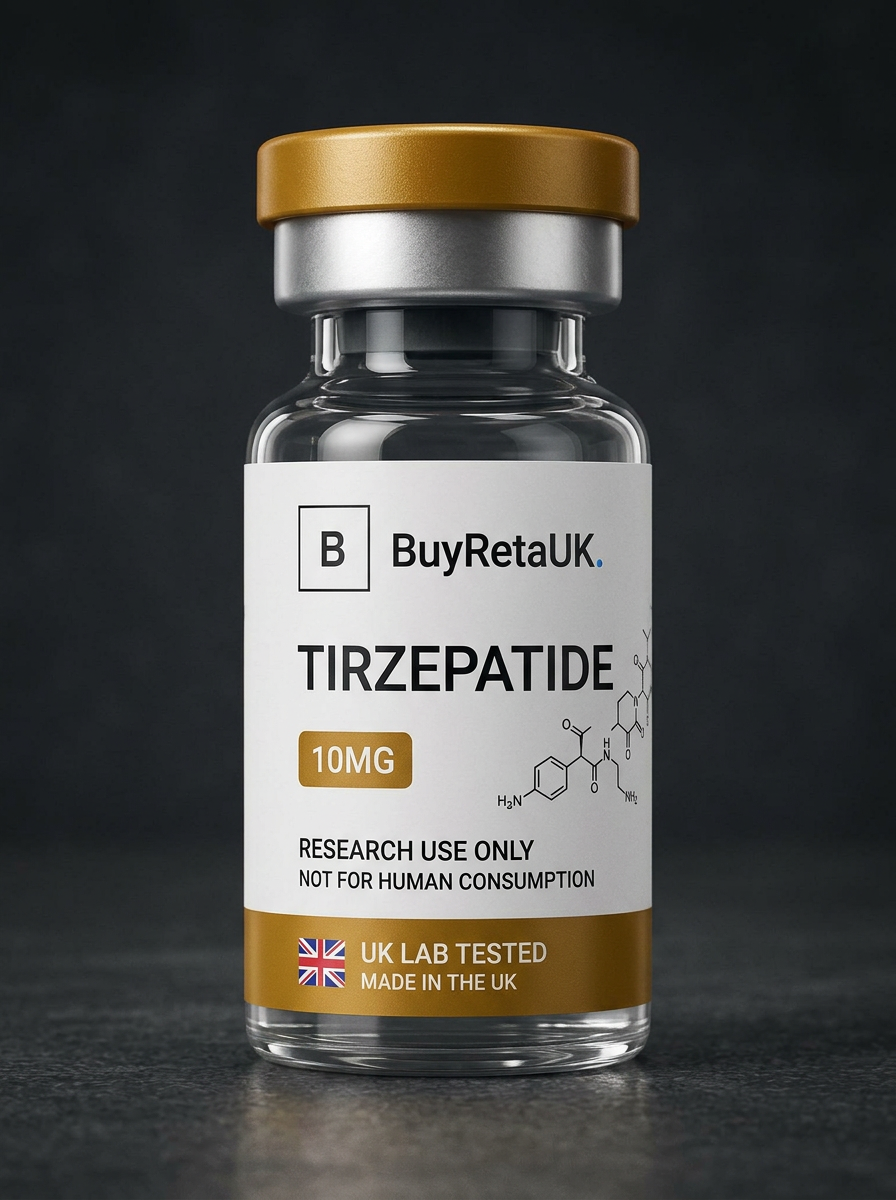
Tirzepatide (development code LY3298176) is a 39-residue synthetic peptide engineered to activate two class-B G-protein-coupled receptors simultaneously: the glucose-dependent insulinotropic polypeptide receptor (GIPR) and the glucagon-like peptide-1 receptor (GLP-1R). Rather than modify a single endogenous hormone, the backbone was designed from a GIP-like starting point and tuned to add balanced GLP-1R activity (Coskun et al., 2018).
Both target receptors are members of the secretin family of GPCRs. They share a large N-terminal extracellular domain that binds the C-terminal helix of the peptide agonist and a seven-transmembrane bundle that engages the N-terminal residues to initiate signalling. In each case the dominant downstream coupling is via the stimulatory Gαs protein, activation of adenylyl cyclase and elevation of intracellular cyclic AMP — leading to PKA and EPAC pathway activation (Drucker, 2018; Campbell & Drucker, 2013).
A C20 fatty-diacid chain is conjugated to the peptide backbone. This does not participate in receptor engagement itself; it promotes reversible albumin binding to extend circulating half-life and support the once-weekly regimens reported in the clinical literature (Frías et al., 2018).
GLP-1 receptor pharmacology.
The GLP-1 receptor is expressed on pancreatic β-cells, on neurons in the hypothalamus and brainstem, and in gastric, cardiovascular and immune tissues. Activation raises β-cell cAMP, potentiating glucose-dependent insulin secretion, and engages central satiety circuitry that reduces food intake and delays gastric emptying (Müller et al., 2019).
Willard et al. (2020) reported that tirzepatide is a biased and imbalanced agonist at GLP-1R — favouring cAMP accumulation over β-arrestin recruitment relative to native GLP-1(7–37). In functional cAMP assays its potency at GLP-1R is lower than at GIPR, which is the source of the "imbalanced" descriptor in the literature. This bias is a distinguishing mechanistic feature of tirzepatide relative to single GLP-1 agonists such as semaglutide.
GIP receptor pharmacology.
GIP is the second major incretin hormone. Its receptor is expressed on pancreatic β-cells, adipocytes, bone and specific CNS regions. β-cell GIPR activation potentiates glucose-dependent insulin release in a manner complementary to GLP-1R engagement, while adipose GIPR activity is implicated in lipid handling and central GIPR signalling in appetite regulation (Campbell & Drucker, 2013).
Tirzepatide behaves as a "GIP-like" agonist at GIPR, with a potency profile close to native GIP(1–42) (Willard et al., 2020). This is the arm that separates tirzepatide most cleanly from single GLP-1 agonists and is the defining pharmacological addition of dual agonism.
Dual agonist signalling.
Simultaneous engagement of GIPR and GLP-1R on the same cell — for example a pancreatic β-cell — produces additive Gαs coupling that raises intracellular cAMP more effectively than either receptor engaged in isolation at matched exposure. Downstream, this translates to PKA-driven potentiation of glucose-dependent insulin secretion and EPAC-mediated effects on exocytosis (Coskun et al., 2018).
Because β-arrestin recruitment at GLP-1R is reduced relative to native GLP-1 (Willard et al., 2020), tirzepatide is associated with reduced receptor internalisation and desensitisation at that arm — a proposed mechanistic contributor to sustained signalling over the dosing interval.
Cellular signalling cascade.
- Peptide binds the extracellular domain of GIPR and GLP-1R.
- Conformational change activates coupled Gαs heterotrimer.
- Adenylyl cyclase converts ATP to cyclic AMP.
- cAMP activates protein kinase A (PKA) and EPAC.
- PKA/EPAC modulate insulin-secretion machinery, satiety-related neuropeptide expression and adipose lipid metabolism depending on tissue context.
- β-arrestin recruitment (reduced at GLP-1R for tirzepatide) governs receptor internalisation and desensitisation.
Pharmacodynamic effects reported in the literature.
- Glucose-dependent insulin secretion from pancreatic β-cells (Frías et al., 2018).
- Suppression of glucagon secretion at hyperglycaemia (Coskun et al., 2018).
- Slowing of gastric emptying and reduced appetite drive (Jastreboff et al., 2022).
- Sustained receptor engagement across a weekly dosing interval via albumin-bound half-life extension.
- Adipose and central GIP-mediated effects on energy balance still under active characterisation.
Why dual agonism matters.
Single GLP-1 agonists access one incretin axis. Adding balanced GIPR activity engages the second incretin receptor at the same cell and expands the pharmacology beyond what GLP-1R alone can reach. The mechanistic result is a receptor signature that cannot be reproduced with GLP-1R-selective peptides, and that requires two-receptor assay coverage to characterise correctly.
For laboratory research, the practical implication is that assay design must span both incretin receptors: cAMP accumulation and β-arrestin recruitment in GIPR- and GLP-1R-expressing lines, ideally as a matched panel. Restricting characterisation to a single receptor systematically under-reports the peptide's pharmacology.
Tirzepatide, Semaglutide and Retatrutide compared.
| Attribute | Tirzepatide | Semaglutide | Retatrutide |
|---|---|---|---|
| Receptor targets | GIPR · GLP-1R | GLP-1R only | GLP-1R · GIPR · GCGR |
| Agonist profile | Balanced dual incretin | Selective GLP-1R | Balanced triple |
| Primary signalling | Gαs / cAMP at both receptors | Gαs / cAMP at GLP-1R | Gαs / cAMP at all three receptors |
| Distinguishing mechanism | Adds GIP incretin axis; biased GLP-1R | Single incretin axis | Adds GCGR energy-expenditure axis |
| Research characteristics | Two-receptor assay panel required | Single-receptor assay sufficient | Three-receptor assay panel required |
| Half-life extension | C20 fatty-diacid → once weekly | C18 fatty-diacid → once weekly | Fatty-diacid → once weekly |
A full side-by-side treatment of the dual vs triple comparison is available in Retatrutide vs Tirzepatide.
Laboratory research relevance.
- Two-receptor characterisation. Report cAMP potency at GIPR and GLP-1R-expressing lines as a matched panel; single-receptor data under-report activity.
- Reference peptides. Use GIP(1–42) and GLP-1(7–37) as anchor points on each receptor.
- Signalling bias. Pair cAMP with β-arrestin recruitment where possible to capture the reported GLP-1R bias.
- Peptide integrity. Confirm identity by mass spectrometry and purity by HPLC-UV before every experiment — see the future Tirzepatide UK hub for batch data.
- Handling. Store lyophilised vials at 2–8°C and use reconstituted material within 30 days at 2–8°C.
- Batch traceability. Log the batch number for every experiment and cross-reference the verification library for the corresponding COA.
Quality standards.
Reverse-phase HPLC quantifies purity as a percentage of total peak area. Release specification: ≥99%.
Learn more →Certificate of AnalysisEvery batch ships with a batch-specific COA reporting identity, purity and appearance.
Learn more →Laboratory QualityIndependent third-party analysis, temperature-controlled UK storage and full batch traceability.
Learn more →Batch VerificationCross-reference the batch number printed on your vial against our live COA library.
Learn more →Storage StandardsLyophilised at 2–8°C protected from light. Reconstituted stability ~30 days at 2–8°C.
Learn more →Buying considerations.
- Require batch-specific analytical data
Mechanism-of-action work is only interpretable if the peptide's identity and purity are documented for the exact batch used.
- Prefer ≥99% HPLC-UV purity
Related-substance impurities can present altered receptor pharmacology and confound dual-agonist assay readouts.
- Confirm identity by mass spectrometry
Identity is not implied by purity — MS confirms the peak in the chromatogram is the intended 39-residue sequence.
- Standardise a single vendor per study
Cross-vendor variation is a common source of drift in comparative receptor-panel experiments.
Frequently asked questions.
What receptors does Tirzepatide activate?[+]
Tirzepatide is a balanced agonist at two class-B G-protein-coupled receptors: the glucose-dependent insulinotropic polypeptide receptor (GIPR) and the glucagon-like peptide-1 receptor (GLP-1R). Both signal predominantly through Gαs and cyclic AMP.
How does dual agonism differ from single or triple agonism?[+]
Semaglutide activates GLP-1R only. Tirzepatide adds GIPR, engaging both incretin receptors simultaneously. Retatrutide extends the profile further with a third receptor (glucagon).
Is Tirzepatide biased toward one receptor?[+]
Reported in-vitro characterisation (Coskun et al., 2018; Willard et al., 2020) describes tirzepatide as GIP-like at the GIPR and biased at the GLP-1R — favouring cAMP over β-arrestin recruitment relative to native GLP-1.
Is Tirzepatide a modified GLP-1?[+]
It is closer to a modified GIP. The 39-residue backbone shares more sequence identity with GIP than with GLP-1, and the peptide was engineered from a GIP starting point to add balanced GLP-1R activity.
What signalling pathways does the peptide engage?[+]
Both receptors couple primarily to Gαs, activating adenylyl cyclase and raising intracellular cAMP. Downstream, PKA and EPAC pathways modulate insulin release, satiety signalling and adipose metabolism depending on tissue context.
How does the fatty-acid tail change the mechanism?[+]
The C20 diacid lipid conjugate does not participate in receptor binding; it extends circulating half-life via reversible albumin binding, which supports the once-weekly dosing regimen reported in the clinical literature.
Why does mechanism of action matter for laboratory research?[+]
Receptor selectivity determines which in-vitro assays are relevant. A dual agonist requires characterisation across both GIPR- and GLP-1R-expressing systems; single-receptor cell lines under-report activity.
Scientific sources & further reading.
- [1]Coskun T. et al. (2018) LY3298176, a novel dual GIP and GLP-1 receptor agonist for the treatment of type 2 diabetes mellitus: from discovery to clinical proof of concept. Molecular Metabolism, 18: 3–14 DOI: 10.1016/j.molmet.2018.09.009DOI →
- [2]Willard F.S. et al. (2020) Tirzepatide is an imbalanced and biased dual GIP and GLP-1 receptor agonist. JCI Insight, 5(17): e140532 DOI: 10.1172/jci.insight.140532DOI →
- [3]Frías J.P. et al. (2018) Efficacy and safety of LY3298176, a novel dual GIP and GLP-1 receptor agonist, in patients with type 2 diabetes: a randomised, placebo-controlled and active comparator-controlled phase 2 trial. The Lancet, 392(10160): 2180–2193 DOI: 10.1016/S0140-6736(18)32260-8DOI →
- [4]Jastreboff A.M. et al. (2022) Tirzepatide once weekly for the treatment of obesity. New England Journal of Medicine, 387: 205–216 DOI: 10.1056/NEJMoa2206038DOI →
- [5]Drucker D.J. (2018) Mechanisms of action and therapeutic application of glucagon-like peptide-1. Cell Metabolism, 27(4): 740–756 DOI: 10.1016/j.cmet.2018.03.001DOI →
- [6]Campbell J.E., Drucker D.J. (2013) Pharmacology, physiology, and mechanisms of incretin hormone action. Cell Metabolism, 17(6): 819–837 DOI: 10.1016/j.cmet.2013.04.008DOI →
- [7]Müller T.D. et al. (2019) Glucagon-like peptide 1 (GLP-1). Molecular Metabolism, 30: 72–130 DOI: 10.1016/j.molmet.2019.09.010DOI →
Peer-reviewed citations are added as each article is expanded. See our editorial standards for our sourcing and accuracy commitments.
Every editorial article is reviewed against our accuracy commitment and quality-assurance checklist before publication. Named reviewer profiles are added as our reviewer network expands.
View profile →How this content is produced.
Every article follows a documented editorial process — sourcing, scientific review, update cadence and correction policy — so researchers can rely on what we publish.
Read the full editorial standards →Your research-to-checkout journey.
Educational first. Each step is optional — start wherever you are in your research.
- Step 1ResearchUnderstand mechanism, class and study context.
- Step 2ComparisonSee how compounds differ in receptor profile.
- Step 3Laboratory qualityHPLC-UV purity, mass-spec identity, endotoxin data.
- Step 4Certificates of analysisVerify your batch in the public COA library.
- Step 5ProductsChoose a strength — every vial ships with COA.
- Step 6CheckoutEncrypted checkout, temperature-controlled UK dispatch.
How to research this topic.
Recommended reading path
- Step 01Start here — What is Tirzepatide?
Dual GIP/GLP-1 receptor overview and research framing.
- Step 02Mechanism of action
How dual receptor engagement drives the incretin response.
- Step 03Research landscape
Published evidence base, SURPASS & SURMOUNT programmes, laboratory applications.
- Step 04Clinical trial evidence
Phase 3 SURPASS & SURMOUNT read-outs and the peer-reviewed literature.
- Step 05Compare with Retatrutide
Dual vs triple incretin agonist — how they differ.
- Step 06Verify a batch
HPLC purity and Certificate of Analysis verification.
- Step 07Storage & reconstitution
Lyophilised storage, bacteriostatic water reconstitution, in-use stability.
- Step 08Browse strengths
Every tirzepatide vial strength available.
- Step 09Buy tirzepatide
UK commercial hub — lab data, COAs and dispatch.
Tirzepatide at a glance.
Topic overview
- Tirzepatide
- LY3298176
- GLP-1
- GIP
- Dual Agonist
- Incretin
- SURPASS
- SURMOUNT
Compare research compounds.
Triple vs dual incretin agonist — receptor profile and research framing.
View comparison →Side by sideSelective GLP-1 agonist vs dual GIP/GLP-1 agonist — receptor pharmacology and evidence comparison.
View comparison →Multi-compoundAll GLP-1 / GIP / glucagon research compounds in one place.
View comparison →Related reference reading.
A laboratory overview of retatrutide (LY3437943) — a triple agonist research peptide acting on the GLP-1, GIP and glucagon receptors.
6 min read →Purity & Laboratory TestingWhat high-performance liquid chromatography measures, why ≥99% purity matters, and how to interpret HPLC traces on a COA.
6 min read →Storage & HandlingHow to store lyophilised research peptides and reconstitute them correctly for laboratory use.
4 min read →RetatrutideBackground on retatrutide in the academic literature — receptor pharmacology, study context and analytical handling.
8 min read →Explore related collections.
The UK commercial hub for research-grade Retatrutide — lab data, COAs and dispatch.
Browse collection →CollectionThe full retatrutide range with research context and lab data.
Browse collection →CollectionEvery GLP-1 / GIP / glucagon research peptide in one place.
Browse collection →Research-grade Tirzepatide & comparators.
Frequently researched together.
Certificate of Analysis.
Every batch of Tirzepatide ships with a third-party HPLC and mass-spec Certificate of Analysis. Browse the live COA library to verify your lot.
Tools & resources.
Frequently asked questions.
Which is the newer research compound?
Retatrutide is the more recently characterised compound in the academic literature, while tirzepatide is the more established reference.
Read: Retatrutide vs Tirzepatide →Is retatrutide approved for human use?
No. Retatrutide is supplied strictly for laboratory research and is not approved for human or veterinary administration.
Read: What is Retatrutide? →What receptors does retatrutide act on?
In published research it has been characterised as a triple agonist acting on the GLP-1, GIP and glucagon receptors.
Read: What is Retatrutide? →How should retatrutide be stored?
Lyophilised vials are stored at 2–8°C, protected from light. Once reconstituted with bacteriostatic water, store refrigerated and use within 30 days.
Read: What is Retatrutide? →Continue your research.
Compound overview, receptor profile and research framing.
Open cornerstone →ComparisonRetatrutide vs TirzepatideDual vs triple incretin receptor pharmacology, side by side.
Read comparison →CommercialTirzepatide UKBuy research-grade Tirzepatide with batch-specific COAs.
Open hub →