For laboratory research use only · Not for human consumptionFree UK next-day delivery
Knowledge journey

Where this sits in the Tirzepatide cluster.

Knowledge journey

  1. collectionGLP-1 Research
  2. commercialTirzepatide UK
  3. guideWhat is Tirzepatide?
  4. guideTirzepatide Mechanism of Action
  5. guideTirzepatide Research
  6. guideTirzepatide Clinical Trials
  7. collectionTirzepatide Collection
  8. collectionTirzepatide Strengths
  9. commercialTirzepatide 10mg
  10. commercialTirzepatide 20mg
  11. commercialTirzepatide 40mg
  12. comparisonRetatrutide vs Tirzepatide
  13. guideTirzepatide Storage
  14. guideTirzepatide Purity
  15. productBuy Tirzepatide
Analytical reference · UK laboratory quality

Tirzepatide purity.

The BuyRetaUK laboratory reference for Tirzepatide purity — what purity means for a research peptide, how it is measured by HPLC-UV, how mass-spectrometric identity is confirmed, and how to verify a batch against its Certificate of Analysis.

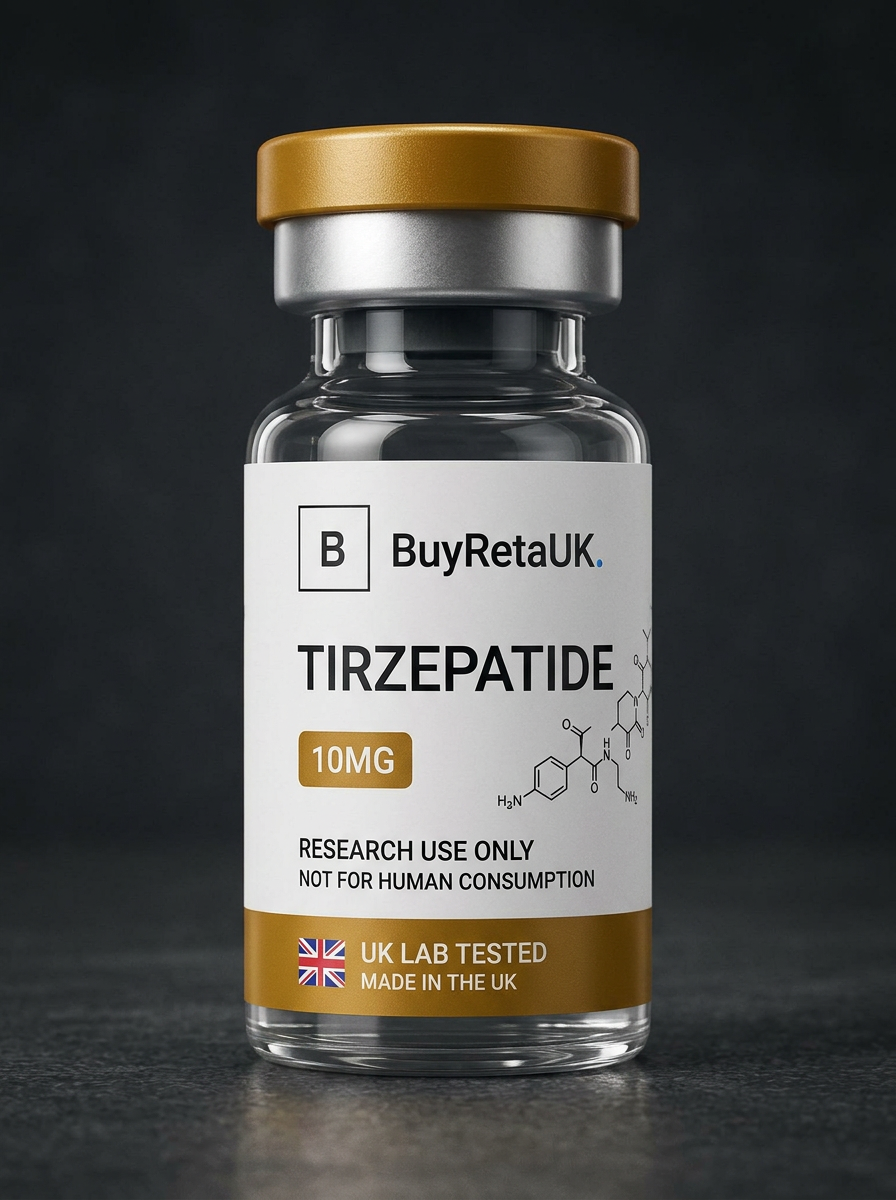
BuyRetaUK Tirzepatide (LY3298176) research peptide vial released at ≥99% HPLC-UV purity
Published
June 2026
Last reviewed
June 2026
Next review
December 2026
Version
v1.1
Reading time
8 min read
Reviewed by
BuyRetaUK Scientific Review Team
Editorial team
BuyRetaUK Editorial Team
Review status
Scientific review complete
Quick summary

Quick summary

Tirzepatide purity is the fraction of target peptide in a batch, measured by reversed-phase HPLC-UV and expressed as area-percent. BuyRetaUK Tirzepatide (LY3298176) is released at ≥99% HPLC-UV with mass-spectrometric identity confirmation, reported on a batch-specific Certificate of Analysis published in the public verification library.

Quick answer

In short.

Tirzepatide purity is the fraction of target peptide in a batch, measured by reversed-phase HPLC-UV and expressed as area-percent. BuyRetaUK Tirzepatide (LY3298176) is released at ≥99% HPLC-UV with mass-spectrometric identity confirmation, reported on a batch-specific Certificate of Analysis published in the public verification library.
Key facts

At a glance.

Compound
Tirzepatide (LY3298176)
Primary purity method
Reversed-phase HPLC with UV detection
Release specification
≥99% area-percent HPLC-UV
Identity confirmation
Mass spectrometry (ESI-MS)
Impurity profile
Individual and total impurities on batch COA
Appearance
White to off-white lyophilised powder
Water content
Reported where determined (Karl Fischer)
Endotoxin
Reported on batch COA (LAL / rFC)
Retained samples
Held for post-release investigation
Intended use
In-vitro laboratory research only
Definitions

Key analytical terms.

Purity (area-percent)
The proportion of the total UV-detectable signal in an HPLC chromatogram that corresponds to the target peptide peak — the industry-standard release metric for synthetic peptides.
HPLC-UV
High-Performance Liquid Chromatography with ultraviolet detection — separates a peptide from its impurities and quantifies each species by peak area at a defined wavelength.
Reversed-phase (RP) HPLC
The dominant HPLC mode for peptide analysis; uses a non-polar stationary phase and an aqueous / acetonitrile gradient with an ion-pairing modifier such as trifluoroacetic acid.
Mass spectrometry (ESI-MS)
An ionisation and mass-analysis technique used to confirm peptide identity by matching the observed monoisotopic mass to the theoretical value for the target sequence.
Related substance
A synthesis-derived variant of the target peptide — e.g. deletion, insertion, oxidised or deamidated sequences — reported separately from unrelated impurities.
Certificate of Analysis (COA)
A batch-specific quality record documenting identity, purity, appearance, and where applicable endotoxin and moisture data at the point of release.
Concept

What purity means for a research peptide.

For a synthetic peptide such as Tirzepatide (LY3298176), purity is an analytical statement about composition. It quantifies the proportion of the target sequence relative to every other UV-detectable species in the batch, measured at a defined wavelength on a defined chromatographic system, and reported as area-percent HPLC-UV — the industry-standard release metric.

Purity is distinct from — but complementary to — identity. Identity confirms that the peak assigned as Tirzepatide is chemically the correct sequence, established by mass spectrometry. A meaningful release specification always combines a purity number with an identity result.

Rationale

Why purity matters in research.

In-vitro receptor and cellular research relies on well-characterised chemical inputs. Undocumented impurities introduce variables that cannot be corrected downstream: an oxidised or deamidated related substance may show altered receptor affinity, a truncated sequence may act as a partial agonist, and an unrelated contaminant may confound assay readouts entirely. High purity narrows the interpretive space of any observed effect. The broader published-evidence landscape for Tirzepatide is documented on the Tirzepatide research page.

Purity also underpins reproducibility. Batch-to-batch variation in impurity profile is a common source of drift in comparative studies. Transparent HPLC-UV release specifications, retained samples and a public verification library let a laboratory tie any anomalous result back to the exact analytical record for the batch in use.

Method deep-dive

HPLC analysis.

High-Performance Liquid Chromatography separates the components of a sample by passing a pressurised mobile phase through a column packed with a stationary phase. For Tirzepatide the standard configuration is reversed-phase: a C18 stationary phase and an aqueous / acetonitrile gradient with a low-percentage ion-pairing modifier (typically 0.1% trifluoroacetic acid). Molecules elute in order of hydrophobicity, and a UV detector records absorbance at a defined wavelength — 214 nm is standard for peptides because it captures amide-bond absorbance directly.

The output is a chromatogram: a plot of UV signal against retention time. Purity is computed by integrating each peak, dividing the target peak area by the total integrated area and expressing the result as area-percent. Careful method development and consistent integration are what make HPLC-UV purity values comparable across batches.

Method deep-dive

Mass spectrometry.

Mass spectrometry answers a different question from HPLC. Where HPLC quantifies how much of the target is present, mass spectrometry confirms what the target is. For Tirzepatide this is typically performed by electrospray-ionisation mass spectrometry (ESI-MS): the peptide is ionised and the observed multi-charge envelope is deconvoluted to the intact monoisotopic mass, which is compared against the theoretical value for the LY3298176 sequence.

An identity result is only meaningful when reported alongside the HPLC purity value. A batch can be analytically pure but the wrong compound if identity is not verified. Both results appear on the batch Certificate of Analysis.

Chromatography

Chromatography overview.

ParameterTypical settingPurpose
ModeReversed-phaseStandard for hydrophobic / amphipathic peptides.
Stationary phaseC18, 3–5 µm, 100–300 ÅOptimised particle and pore size for peptide separation.
Mobile phase AWater + 0.1% TFAIon-pairing modifier improves peak shape.
Mobile phase BAcetonitrile + 0.1% TFAElution strength; delivered as a gradient.
DetectionUV at 214 nmDirect amide-bond absorbance; broadly quantitative for peptides.
InjectionLow-µL, dilute solutionAvoids column overload and peak distortion.
Run timeMethod-dependentLong enough to resolve late-eluting related substances.
Batch verification

Batch verification.

Every BuyRetaUK Tirzepatide batch carries a unique batch number printed on the vial label. That batch number resolves to a specific analytical record — HPLC-UV chromatogram, mass spectrum, appearance, moisture (where determined) and endotoxin (where applicable) — held on file and published in the public verification library.

Bench verification is a two-step process: read the batch number from the vial, then confirm the matching COA in the library reflects the release specification you expected. Any mismatch — batch number absent, purity below release specification, identity result inconclusive — should stop use of that vial until resolved.
Documentation

Certificate of Analysis.

A Certificate of Analysis is the batch's release document. For Tirzepatide it typically reports: compound and batch identifier, appearance, HPLC-UV purity (area-percent), mass-spectrometric identity, largest individual impurity, total impurities, water content where determined, and endotoxin where applicable. The full anatomy of a COA — section by section, with worked examples — is covered in the Certificate of Analysis guide.

Quality framework

Laboratory quality.

Tirzepatide is released against the peptide-specific quality attributes described in USP General Chapter <1503> and the specification framework of ICH Q6A, with impurity thresholds informed by ICH Q3A and analytical procedures qualified under ICH Q2(R2). Method suitability, retained samples and supplier qualification are documented on the laboratory quality page — kept concise here to avoid duplication.

Laboratory quality

Quality standards.

Watch-outs

Common misconceptions.

Higher purity is always meaningfully better
Above ≥99% HPLC-UV, differences are within analytical noise; consistency and identity matter as much as the headline number.
Purity guarantees potency
Purity is a compositional metric, not a functional one. Potency is confirmed in a receptor or cellular assay against a reference.
A COA proves the vial in your hand is pure
The COA reflects the batch at release. Post-release storage and handling determine whether the vial still matches its specification.
HPLC alone is enough
HPLC quantifies purity but does not confirm identity. Mass spectrometry is required for the identity result.
All impurities are equivalent
Related substances and unrelated contaminants have different implications for study interpretation and are reported separately.
Purity is stable indefinitely
Peptide degradation continues after release, driven mainly by temperature, moisture and freeze-thaw cycling.
Best practices

Laboratory best practices.

  1. Retrieve and read the batch COA before opening a new vial.
  2. Cross-check the batch number on the vial label against the COA in the verification library.
  3. Log the batch number, release purity and identity result in the experimental record.
  4. Handle lyophilised material and reconstituted stock according to established peptide handling practice to protect the released specification.
  5. Use the reconstitution calculator to convert vial strength into consistent working concentrations across batches.
  6. Repeat critical experiments across at least two independent batches to detect batch-to-batch drift.
  7. Escalate any batch that fails visual, purity or identity checks before further use.
Before you buy

Buying considerations.

  • Require a batch-specific COA

    Never accept a vendor's generic quality statement — every batch should resolve to its own analytical record.

  • Look for orthogonal methods

    HPLC-UV for purity, mass spectrometry for identity — both should appear on the COA.

  • Prefer transparent verification

    A publicly indexed COA library lets you confirm your batch without vendor intermediation.

  • Standardise on one vendor per study

    Consistent release specifications and impurity profiles reduce a common source of batch-to-batch drift.

FAQs

Frequently asked questions.

What does 99% purity mean for Tirzepatide?[+]

It means ≥99% of the UV-detectable material in the release HPLC chromatogram corresponds to the target Tirzepatide peak, with <1% distributed across all other detectable impurities. It is a release-time analytical statement, not a claim about long-term stability.

Which method establishes Tirzepatide purity?[+]

Reversed-phase HPLC-UV is the primary quantitative purity method. It is complemented by mass spectrometry for identity confirmation, and where relevant by Karl Fischer moisture determination and LAL / rFC endotoxin testing.

How is Tirzepatide identity confirmed?[+]

Tirzepatide has a defined theoretical monoisotopic mass. Electrospray-ionisation mass spectrometry (ESI-MS) is used to confirm that the peak assigned as Tirzepatide in the HPLC chromatogram corresponds to the correct sequence within instrument mass accuracy.

What is the batch-verification workflow?[+]

Read the batch number printed on the vial label, open the matching Certificate of Analysis in the public verification library, and confirm the reported HPLC-UV purity, identity result and impurity profile match the release specification before use.

How does purity relate to research reproducibility?[+]

Undocumented impurities introduce variables that cannot be corrected downstream. Consistent, transparent HPLC-UV release specifications and a batch-level COA record allow anomalous results to be traced back to the exact analytical record for the batch in use.

Can purity change after release?[+]

Yes. Purity at release reflects the batch at QC. Post-release degradation from poor storage, moisture ingress or repeated freeze-thaw cycles can reduce effective purity. Handling detail lives on the Tirzepatide storage page.

Is a purity number alone sufficient?[+]

No. Purity must be paired with an identity result. A batch can be analytically pure but chemically the wrong compound if identity is not independently confirmed.

Does BuyRetaUK publish COAs for every Tirzepatide batch?[+]

Yes. Every batch is indexed by batch number in the public verification library, and the label batch number must match the published COA exactly.

References

Scientific sources & further reading.

  1. [1]United States Pharmacopeia (2023) General Chapter <1503> Quality Attributes of Synthetic Peptide Drug Substances. USP-NF
  2. [2]ICH Harmonised Guideline (1999) Q6A Specifications: Test Procedures and Acceptance Criteria for New Drug Substances and New Drug Products. International Council for Harmonisation
  3. [3]ICH Harmonised Guideline (2006) Q3A(R2) Impurities in New Drug Substances. International Council for Harmonisation
  4. [4]ICH Harmonised Guideline (2022) Q2(R2) Validation of Analytical Procedures. International Council for Harmonisation
  5. [5]Snyder L.R., Kirkland J.J., Dolan J.W. (2010) Introduction to Modern Liquid Chromatography (3rd ed.). Wiley
  6. [6]Coskun T. et al. (2018) LY3298176, a novel dual GIP and GLP-1 receptor agonist for the treatment of type 2 diabetes mellitus. Molecular Metabolism, 18 DOI: 10.1016/j.molmet.2018.09.009DOI →

Peer-reviewed citations are added as each article is expanded. See our editorial standards for our sourcing and accuracy commitments.

Editorial team
BuyRetaUK Editorial Team
Author · BuyRetaUK

The BuyRetaUK editorial team publishes laboratory-focused reference content on research peptides, analytical methods and Certificates of Analysis. All articles are written for in-vitro research contexts only.

View profile →
Scientific reviewer
BuyRetaUK Scientific Review Team
Scientific reviewer

Every editorial article is reviewed against our accuracy commitment and quality-assurance checklist before publication. Named reviewer profiles are added as our reviewer network expands.

View profile →
Editorial standards

How this content is produced.

Every article follows a documented editorial process — sourcing, scientific review, update cadence and correction policy — so researchers can rely on what we publish.

Read the full editorial standards →
Commercial journey

Your research-to-checkout journey.

Educational first. Each step is optional — start wherever you are in your research.

  1. Step 1ResearchUnderstand mechanism, class and study context.
  2. Step 2ComparisonSee how compounds differ in receptor profile.
  3. Step 3Laboratory qualityHPLC-UV purity, mass-spec identity, endotoxin data.
  4. Step 4Certificates of analysisVerify your batch in the public COA library.
  5. Step 5ProductsChoose a strength — every vial ships with COA.
  6. Step 6CheckoutEncrypted checkout, temperature-controlled UK dispatch.
Recommended reading path

How to research this topic.

Recommended reading path

  1. Step 01
    Start here — What is Tirzepatide?

    Dual GIP/GLP-1 receptor overview and research framing.

  2. Step 02
    Mechanism of action

    How dual receptor engagement drives the incretin response.

  3. Step 03
    Research landscape

    Published evidence base, SURPASS & SURMOUNT programmes, laboratory applications.

  4. Step 04
    Clinical trial evidence

    Phase 3 SURPASS & SURMOUNT read-outs and the peer-reviewed literature.

  5. Step 05
    Compare with Retatrutide

    Dual vs triple incretin agonist — how they differ.

  6. Step 06
    Verify a batch

    HPLC purity and Certificate of Analysis verification.

  7. Step 07
    Storage & reconstitution

    Lyophilised storage, bacteriostatic water reconstitution, in-use stability.

  8. Step 08
    Browse strengths

    Every tirzepatide vial strength available.

  9. Step 09
    Buy tirzepatide

    UK commercial hub — lab data, COAs and dispatch.

Topic overview

Tirzepatide at a glance.

Topic overview

Comparisons
Knowledge Hub
Collections
Shop
Common pairings

Frequently researched together.

Batch verification

Every batch of Tirzepatide ships with a third-party HPLC and mass-spec Certificate of Analysis. Browse the live COA library to verify your lot.

Research tools
FAQ
Is HPLC the only purity test that matters?

HPLC is the primary purity metric, but identity (mass spec) and endotoxin testing are also important components of a complete COA.

Read: Understanding HPLC Testing
Are batches tested in-house?

Identity and purity are confirmed by independent third-party laboratories — not by us — so the result is impartial.

Read: Laboratory Quality Standards
Where can I view BuyRetaUK COAs?

All current batch certificates are listed on our verification page and linked from each product.

Read: Understanding Certificates of Analysis
What purity should I expect?

Our research peptides are released at ≥99% HPLC purity unless otherwise stated on the product listing.

Read: Understanding Certificates of Analysis
Next steps

Continue your research.